Hearing is Odd

I have read The Universal Sense: How Hearing Shapes the Mind by Seth S. Horowitz. You should read it too, it’s fantastic. I am now qualified to state: sound is weird. Hearing sound is stranger still. A florescent bulb sounds like a chainsaw to a fly. The sun would sound like a jackhammer but for the vacuum of space. This is surprising in the way that affects those people who haven’t thought about it before. There’s a line in the introduction where it’s said that to a frog, the sound of street traffic would be equivalent to a mid-range earthquake. Extended out to other animals, it’s worth considering that humanity and all the sounds our terrible machines produce are geological scale disaster volume-wise. After all, there’s been very little time for evolution to adjust to our roar. This becomes stranger when one considers the way a mammals ear works.

Sound occurs at the level f molecules. This bit of nitrogen bumps into this other bit and then oxygen and argon and whatever else is in the air between a source of noise and the apparatus that hears it. This is why it’s “silent” in space, too few molecules, at least for our ears. Think about how sound works for dolphins or whales, they hear well under water; there anatomy is adapted to it. We hear well in the atmosphere; our anatomy is adapted to it. Surely some Lovecraftian horror can hear well in space, with a hypothetical anatomy adapted to it. Consider Venice. It’s limestone buildings and low traffic streets conspire to absorb the vibrations the way that foam egg-carton stuff does in recording booths. It’s all physical, environment affecting sound at least as much as anatomy.

Technology can actively manipulate both, and that’s interesting. Sound itself can manipulate sound. If we have an audible thing and it’s particular waveform looks like peak, we hear that. If we add an audible thing to it and that things particular waveform look like a valley, an inverse of the peak, we hear nothing. That’s real, that’s how active noise cancelling works in headphones.

Now, I’m starting to conceive that anatomically someone could be missing the mechanical anatomy to hear the valley everyone else hears. Such a person wouldn’t hear silence like everyone else, they would hear something. I hope to hear nothing.


How Not to Hear Voices

Things who speak, have a voice. Things who listen have ears, commonly two. A human head doesn’t seem particularly wide, though it’s wide enough for direction finding. Eyes are even closer together and still provide depth perception, after all. Somehow I have found myself in the position of needing to read about hearing. I seem to recall that I’ve gotten here by reading about perception and consciousness. There is something that it is like to be a blank,  that sort of thing. From that ultrasound and infrasound, and moths with impaired hearing being more commonly predated by bats. Hunters and hunted evolved their capacities. Human people gained capacity via technological advancement. This compressed time. Now I need to know more about where we are. If it’s different from where we would be if we did things the natural way.

Unfortunately this borders on the wrong kind of field, the sort in which I want to cut no trails.

Safe routes should always be taken. Stick to the coastline. Keep it rooted in mechanics. Think about how physical it is. Focus on the externalities. Reject that which is perceived with one sense alone. Touch the wall for reassurance. Have a plan. Overwhelm the input and leave no room for the unwelcome. Denial is food for it. Inattention is the best response. Don’t flinch. Don’t look. Hug the ground and abhor the deep and unsoft dome of sky. Avoid distance. Stick to chamber music, made in small rooms, without speaking.

Well, time to read The Universal Sense: How Hearing Shapes the Mind by Seth S. Horowitz. It’s already terribly frightening. Still, everyone should buy it, I need this sort of book to exist

Stereo Discomfort

For things of a certain age the word stereo is redundant. By this it is not meant that simply having a multi-physical-format media player is now limited to the same cohort which has a landline phone. The electronics section and the media center sub-set pages of the J.C. Penny catalog were once aspirational window shopping. Printed catalogs died along with shopping malls and window shopping. If it’s audio, chances are it’s stereophonic.

Today music is often played through headphones and automobiles. The source is a digital file, owned, or stolen, or streamed. The closest thing to a media center is a television with 5.1 Dolby surround and an automobile with an AUX cord. Music is as popular as ever it’s just not a thing to be owned any more. The average home doesn’t have a pilfered milk crate of vinyl, and the average car doesn’t have a Case-Logic binder of compact disks. Maybe there’s a list of purchases or followed artists from one digital media purveyor or another. No one’s lending out their favorite album, they’re sharing a playlist; not handing over a mixtape.

More often than ever sound is coming in through headphones. This is nice because there’s apt to be a variety of tastes on train. It’s also awful because hearing things that aren’t externally verifiable is made worse by sound that makes me feel like I’m inhabiting space. The soundstage of a pair of headphones has the power to be a terrible thing. Headphones on and sound flowing everything is coming from all over. Not reacting to things so no one can tell I think there’s something there is hard enough; I don’t want to hear the vocals coming in from the left. Hey Alexa, you sound very nice today, it doesn’t bother me one bit that you’re mono, I actually prefer it.

A lot of things have two of everything. This is both for redundancy and for location tracking. It takes two eyes to estimate a distance. It takes two ears to place the source of a sound. Having one mouth is very common, and in the beginning audio playback devices had one mouth as well. Everything spoke monaural audio from a point source. Then recordings and playback devices went stereophonic. Sound is now three dimensional. Properly mixed, stereo sound can be made to move around the listener. Tiny changes in phase, time, and balance, all can produce a dynamic soundstage, and it’s hard to ignore. In certain genres of music practically every sound is moving from one side to the other or falling down from above.

The things that do the mixing show off. This isn’t a living room, or an airplane, or an office, this is a concert hall; it’s a space you’re being forced into. No one could possibly want that. The solution is obvious, play your audio of choice through an Amazon Echo, or find something, anything, portable, that puts out mono. Thank you to the companies behind the Tanashin clone cassette mechanisms. Yes, cassettes are the simplest way to go portable with mono audio.

Digital files you “physically” own can be mixed down to mono and is probably worth the effort. If the device has a headphone jack a stereo to mono adapter can be put in-line, if you don’t mind a three inch inflexible extension at the start of the headphone cable. With a cassette tape, you just need to buy a (probably cheaper) Walkman that has a mono tape head. Cassette recorded in stereo? Put it in the IT’S OK Bluetooth 5.0 cassette player and it’s mono whether going wired or wireless! Hurry though, they made a stereo version, the IT’S OK TOO Bluetooth 5.0 cassette player, and it seems they’re just selling off the remaining stock of the beautiful mono version.

Never mind the people who say it’s crap, that no one makes a good cassette mechanism anymore. This is not about that. I’m all about popping in Peace For Animals and finally managing to read without feeling like I need to turn my head and make sure there’s nothing over there. Stereo is around you, someplace. Mono is inside you, perfect, like the light in your lungs. Listen in mono, IT’S OK!

Pale Horse

I didn’t realize for a long time, like way longer than your might think, that not everyone heard voices. I mean, you’d think I would have picked up on that. Like, I knew that I could hear mine, and other people couldn’t, but it never occurred to me that other people didn’t have their own that they could hear and I couldn’t.

I don’t talk about my voices. I mean, I admit to them, but I don’t talk about what they say. That’s over now. I get very upset by what I hear which is weird ‘cause I don’t think other people would be upset by hearing the same things.

One voice I hear pretty clearly. It’s generally asking me questions. It asks me about horses fairly regularly. “What about the horses?” This is very annoying. It’s not very upsetting. The other voice is not very clear. It says things like “no” and my name a lot. It says a lot of other things I don’t really catch, like I hear it but not quite. Like, I want to ask it to repeat itself but I think that’s the idea, so I don’t.

The second voice is very upsetting. It’s distracting, it makes me feel panicky and raises my heart rate to where I can feel it so I get to worrying if I’m going to have problems with my heart again which makes me more upset.

Here’s a horse.
Here’s a pale horse.

Pause

There’s this weird thing about painting. I still notice it. Not so much anymore, but still. It’s waiting. Painting is like photography is for me that way. See when I draw and can just start drawing and stop when I’m done. If I’m painting I have to stop and wait. Paint this bit, now it needs to rest, dry at least a little. That can be weird. It helps to have something to do while I wait. Something with sound and a need for real focus.

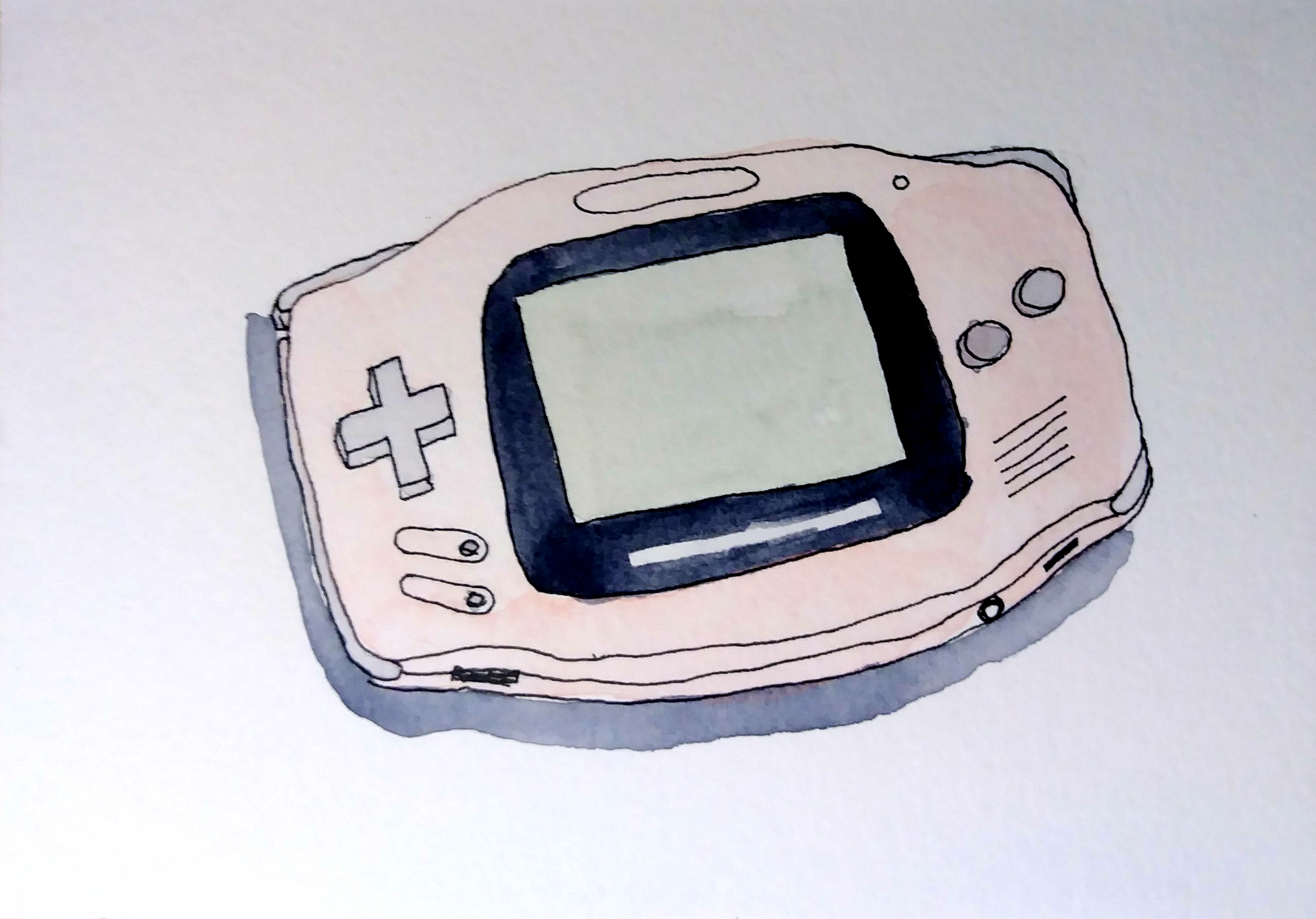
My Gameboy Advance helps with that. Mindless but urgent games are the most useful, Tetris or Dr. Mario, or Doom, something like that. Where you turn yourself off and try not to die. It’s good for the voices. The way painting and drawing are too.