Found Audio Three

Panasonic released microcassets four to a set in a plastic case that was nominally the size of a standard cassette case, though thinner. The four here appear to be recordings of the proceedings of the board of the Yuma Venture RV Park, Yuma Arizona in the Southwest United States. For a place with RV in their name, their lone photo on Google maps shows only trailer homes. The first three tapes date to November 11th 1998 and are recorded on side A only. The final tape is marked in faded pencil with the date March 10th 1999. It’s a strange window into the goings on in a particular type of community just before the turn of the century. There’s something to be read into a man relaying the same anecdote about a pavement seal-coater in two meetings almost four months apart; something about the pace of life perhaps or what it takes for something to rise to the status of a 3.

11 November 1998 #1
11 November 1998 #2
11 November 1998 #3
10 March 1999 Side A
10 March 1999 Side B

I wonder how much of this sort of thing exists out there in the world, sitting in boxes slowly shedding magnetic oxides. The digital dark age has probably put more of this sort of thing out there, everyone has a voice recorder in their pocket these days. Sadly, no one’s selling access to used Google Drives, iClouds, or OneDrives that I know of.

Found Audio Two

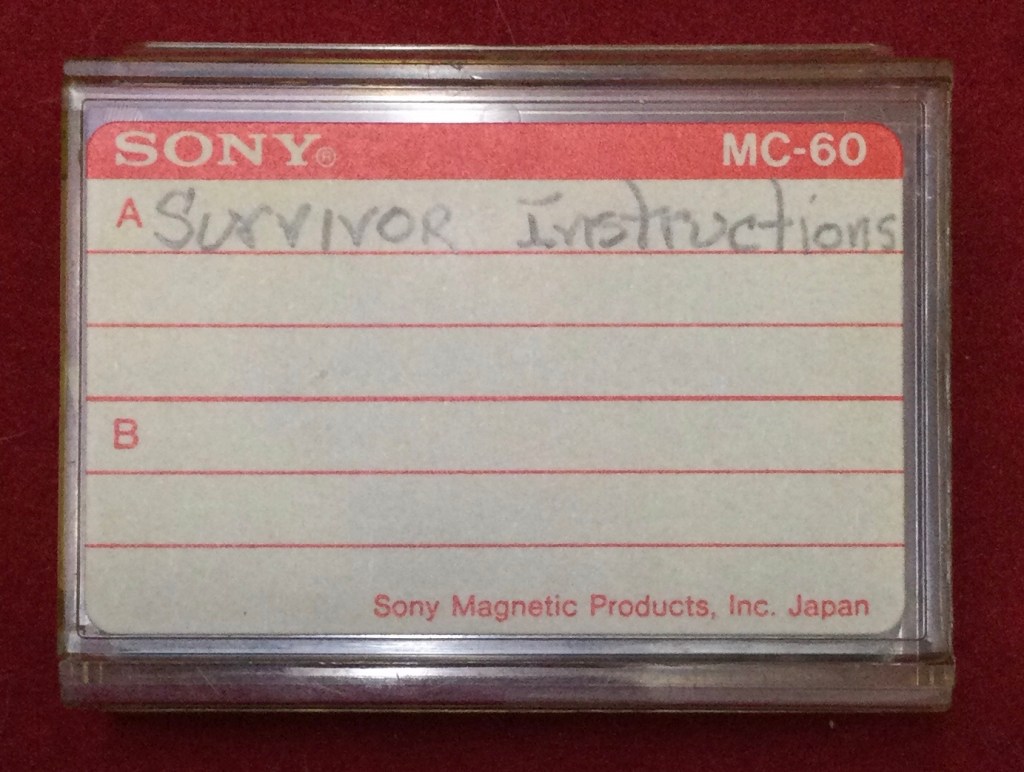
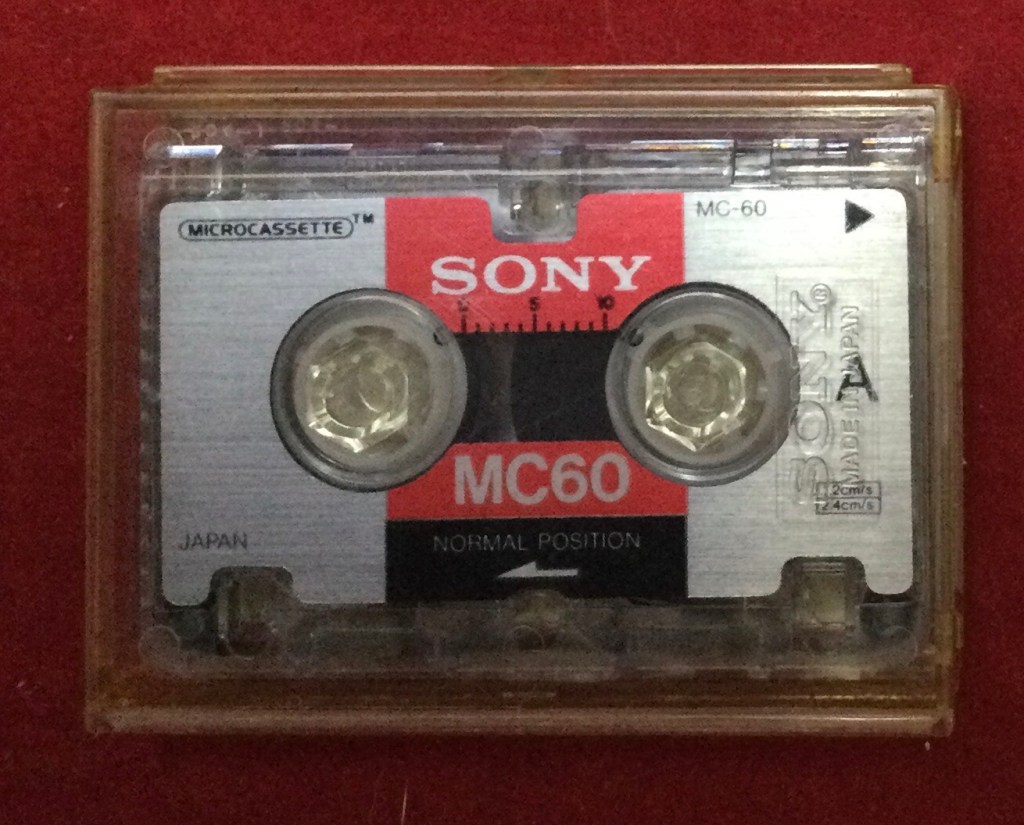
Another microcassette recording. For some reason the creator of this audio recorded it at half speed, 1.2 centimeters per second instead of the usual 2.4 cm/s speed. This provided two hours or recording time on the 60 minute Sony tape. Having listened to the whole thing, there’s only five minutes of audio. Presented here with no post processing, it feels unkind to make this sort of thing clearer or otherwise easier to decipher.

Survivor Instructions

Slow or Stuck Shutter Repair for Amateurs

So you got yourself an old camera, old like from the mechanical camera age, not old like from the battery-powered point-and-shoot era. It’s made of metal, not plastic and if the wrap’s intact it looks like leather ‘cause it is. You probably have a lever that cocks the shutter and something that orbits the lens to change the aperture. More than likely you’ll find the camera isn’t operating at full capacity. I put such cameras into one of three groups (always three).

Group One: it basically works. You can focus, set the aperture, cock the fire the shutter, and wind the film on for the next shoot. If you got low standards and can put up with some unpredictable behavior you could go out and have a great time.

Group Two: something doesn’t work. Maybe the focus is so stiff you just always shoot things from 15 feet out. Could be the shutter fires but is like seriously slow, or doesn’t manage to close unless you take your finger off the release even when it’s on 1/50th instead of B. It might have been a whizz-bang tack sharp beauty, but these days it’s got that Lomography aesthetic in spades.

Group Three: it’s a camera shaped paperweight. Someone sold this as a décor item but you were feeling lucky. It may be haunted by the ghost of George Eastman.

A professional could put in the time with their specialist tools and rarefied skills to get any of the above restored. You, like me, do not have those tools or skills and are not willing to leave the trail of bodies in your wake that it’ll take to try and acquire them. Stripped screws, lost springs, gouged metal, and a box of “parts” is all that’s in the cards for any camera with the misfortune to become an attempted aspirational repair. Good news, we’re not doing that. We don’t need any special tools and even if we fail we’re not ending up with a pile of parts that’ll never be a camera again. So what do you need? Patience and heat.

Camera people talk about getting a camera CLA’d. Cleaned, Lubricated, and Adjusted. The important word there is lubricated. Cameras have metal moving parts. Metal on metal is pretty much always lubricated. As with mechanical watches, mechanical cameras tend to use very thin and light lubricant. Thin and light lubricant tends to get thick and tacky after fifty or more years collecting dust. So let’s open it up and spray on the contact cleaner, right? Oh goodness no, that sounds hard. Let’s watch a movie instead.

We Are Now Camera Technicians

If you have a group one camera, put on a movie, or sit down for a couple episodes of some soon-to-be-canceled Netflix series or ultra-niche podcast. Set a speed, cock the shutter and fire. Then do it again, repeatedly, for every speed, again and again until you run out of media to consume or the will to sit still. Slide the aperture ring back and forth again and again. Focus from one extreme to the other. Get a rhythm going and keep at it. Friction turns to heat that slowly but surely leads to a softening of old lubricant and often it’s enough to clean out the cobwebs so to say and you end up with a reliable camera.

If you have a group two or three camera you’ll be doing the mindless zombie cock-and-fire, twist-and-turn, television session as well. Before you give that a try though, you’ll be baking your camera. If you’re camera’s a folder, open it up. Open the film door too. Now apply heat. If you have a sunny window, push the sleepy cat aside (but apologize with some treats and a dime bag of catnip) and stick your camera in that sunbeam. Hopefully for at least an hour. If it’s overcast, if there’s a draft, or a sunny window is otherwise not an option try putting it in a pot on a radiator. Or preheat your oven at its lowest setting for a good twenty minutes, turn it off, and then pop the camera in for a half hour or more like you’re waiting for bread dough to rise. Like with the radiator though, don’t just sit it on the rack, stick it on a baking sheet or something. With the radiator you want something heavy to help diffuse the heat. In the oven it’s more about keeping it stable on a wire rack.

Remove your camera from whatever heat source you used while it’s still warm. It should be warm, not uncomfortable to hold but more than body temperature. Now go through the motions, adjust the focus and aperture, cock and fire the shutter on all the speeds. You’ll probably find things that were frozen in place before move at least a little now. If you made noticeable improvements, repeat the heating cycle and have another go. If you don’t see any change, well, that’s unfortunate. More heat is not the answer.

Violence. Violence is the answer. Gentle violence. Yes really. If the cameras a folder close it all up and give it a few hammers into your open palm. Don’t do it so hard that you’ll hurt your hand and you can be sure it won’t be so hard as to hurt the camera. Now try that stuck shutter again. If you made a little progress, try a heat cycle again. Then try working all the movements again.

There’s a limit to how much good you can do without taking things apart or spending the money on a professional. If something is genuinely mechanically busted you won’t fix it with a touch of heat, but you won’t turn a mostly working camera into a pile of unusable parts either. I can tell you though, that first time you start with a seized up shutter and come away with a working camera it’s a great feeling.

Acufine Diafine Divided Developer Lifespan

The internet says Diafine lasts forever. Search, it’s out there all over the place. No one talks time though. They just comment things like “It ran until I contaminated the B solution with A”, or “The volume of A got so low I just mixed up another batch”. That’s great, but I don’t want to know that. This isn’t going to be that, this is going to be dates.

My Diafine was mixed up July 2018. In the following several months I ran thirteen rolls of 120 and fifteen rolls of 135 (I know because I make hash marks on a masking-tape label on the bottle). A couple of the rolls of 135 were twenty four exposure, but the rest were all thirty six. Then, in December, some shit went down and the bottles sat on a shelf in a friends basement until, well, today. Solution A was in a white PTFE bottle and solution B was in a plastic coated amber glass bottle. That wasn’t a conscious choice beyond my wanting different bottles so I could tell them apart, and it was what I had. It also helped that solution B could go in a Brown bottle.

Just ran a roll of Arista EDU Ultra 400. Came out fine. With chemistry that was mixed up four years and nine months ago.

I can’t comment on how long it lasts in terms of rolls processed, I’m sure there are folks who have gone way over thirty rolls and I’m a roll short of that even now. I do feel it’s useful to say after almost five years, it’s still working as well as when I mixed it. Let it be said, the working shelf-life if Diafine developer is at least five years.

One tip I’d like to add though. Solution A will decrease in volume faster than solution B. This is because, in general, solution A is hitting a dry film and absorbing into the emulsion. When you pour solution A back into your stock bottle whatever absorbed into the emulsion stays behind. That can be avoided by adding a minute or two of a plain water soak at the front end of your processing. The water doesn’t noticeably affect the action of solution A and it cuts down on how much of solution A is “wasted” just wetting the emulsion.

The Best 6×6 Camera

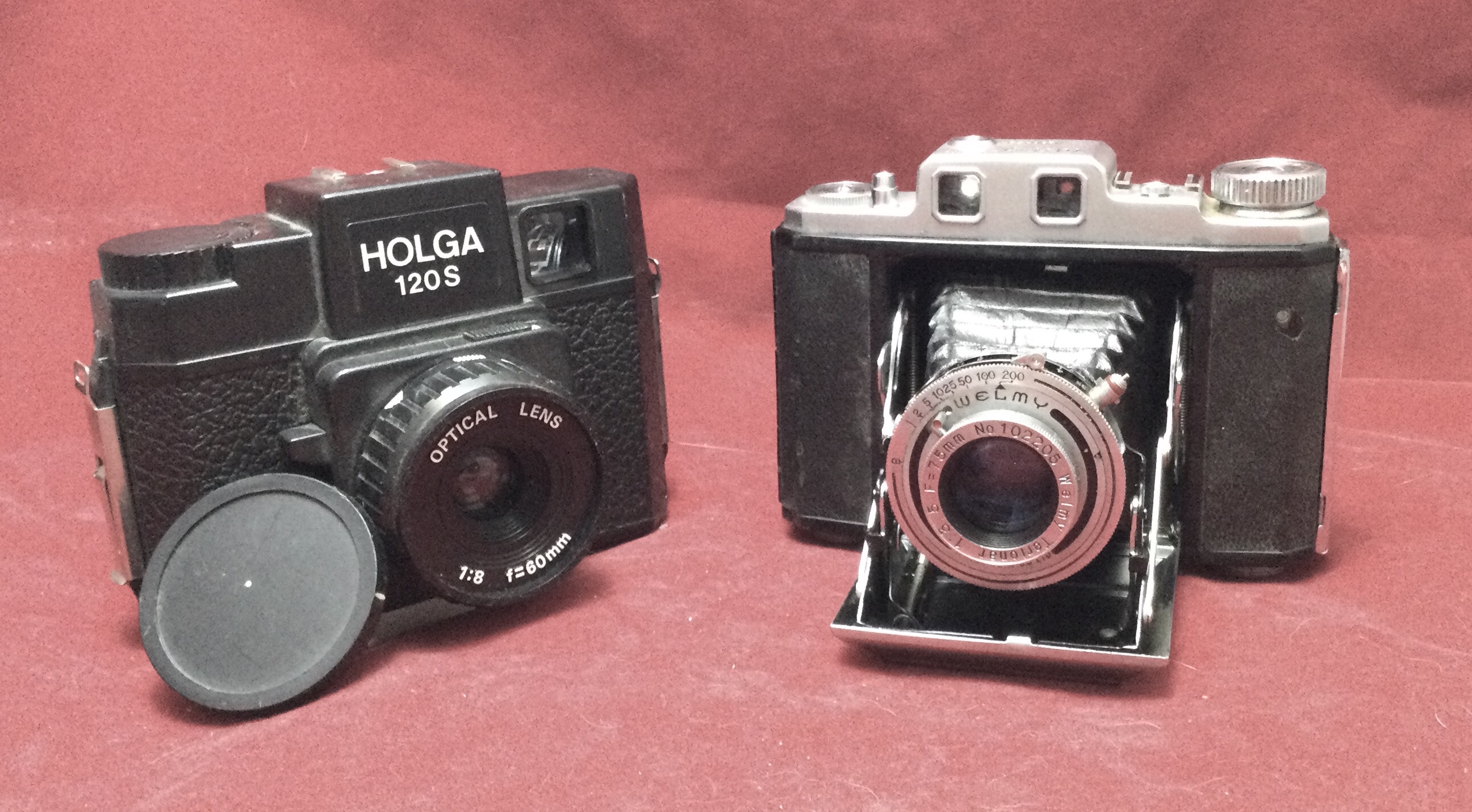
Holga 120S & Welmy-Six

Nobody asked but today I’m going to tell you what the very best 6×6 camera is. To do that I’m going to bring out two cameras. One is world famous, popular, frequently stupid expensive, and is used by a great many working and fine art photographers. The other is commonly available, often a fantastic bargain, and if it’s used by anybody who is anybody—nobodies admitting it. I’m talking of course about the, did I say famous, I meant infamous Holga 120S and the Welmy-Six.

First the one you’ve heard of. The old Holga 120S is a shelter dog if ever there was one. It’s a dog, but a mutt for sure, and if you put in the time it’s a great companion. Just don’t count on waltzing into the AKC show with it unless they already know you there, and your name is a draw.

So forget the metaphor. You’re not going to break into the world of fine art with a Holga, you’re just not. You want to do that you better be some kind of salesman ’cause let me tell you now honey, it doesn’t matter how good a photographer you are. There’s more terrible shooters with big names and well known images on the wall than you’d believe. Wanna get in there too you better know a guy, have a hook, and line up a buyer before you let anyone bother to decide you’re any good or not! Hell, I’m terrible and that’s never kept me from making money at this.

Why the Holga 120S then? Three reasons (ALWAYS 3! THERE’S ONLY EVER 3) it’s light as a feather, dead simple, and nothing special. Which means you won’t think twice about shoving it in your bag or hanging it around your neck. It’s an easy camera to have with you. 33.3% of everything is being there with a camera. Want another truth? Give someone more than one shutter speed, more than one aperture, they’re gonna get some shit frames. A new photographer with a manual SLR without a TTL meter is going to have more impossible to print frames out of 12 than a new photographer with a Holga. A digital workflow can cover up a lot of sins; it’s easier to just shoot better. One aperture, one speed, if you got enough wits to be breathing on your own you’re gonna get 12 frames out of 12 on a Holga. Maybe over a few stops, maybe under, but short of shooting with filters and flash oh-fucking-well you gotta live with it and make it work in the darkroom.

Then there’s the Welmy-Six. It’s nothing special. What it is is a fully mechanical 6×6 folder with just enough features. Cold shoe? Check. Flash sync? Check. On-body shutter release? Horizontal view finder? Vertical view finder? Check check check. Alright, so the lens only opens up to three.5, the shutter only hits 200, 100, 50, 25, 10, 5, two, one & Bulb, and you gotta eyeball your focus. Who cares, it’s a hell of a lot cheaper than an Olympus Chrome 6 or any of the big name 6×6 folders. I got mine from the original home of the overpriced camera, eBay, and it was still under $20 including shipping.

So why buy a Welmy if I already had a $16 Holga? Pockets. The Welmy is a folder so never mind a lens cap and a case, just close it up and it fits in a jacket pocket. Maybe don’t go pocketing it if you live in a bad neighborhood though. It’s heavy and cops will claim it looks like you’re carrying and hassle you. But anyway, yeah, it’s not folding as flat as a Kodak Autographic, but it’s giving me 12 frames of 6×6 instead of 8 frames of 6×9. Oh, and it focuses down to around a foot (the last marked distance on the lens is thee) so table top studio work is very much an option, an option the vertical viewfinder, really does make easy.

The best though? I claimed to know the best 6×6 camera.

The Welmy-Six is basically a Kodak Retina for 120 film, it has that feel. I wrote it above but I’ll do so again, it’s less expensive and easier to get a hold of than any comparable camera in that format. The Lomography crowd isn’t interested because it’s not a Holga or a Diana. The gear heads are after the “serious” brands and they’re all looking for rangefinders and SLRs anyway.

The Holga 120S (forget the other variants) is chunky but weighs nothing. Every time you wind and hit the shutter you’ll end up with something you’ll consider usable; even if the reason you do so is the lowered expectations that automatically activate when you know it was shot with a Holga. There’s so many out there that unless you’re buying new from one of those stores you’ll be able to find one for cheap.

The best then, it’s one of those two. Which, depends on where you are in your film photography journey. One of these cameras speaks with your voice.

Stereo Discomfort

For things of a certain age the word stereo is redundant. By this it is not meant that simply having a multi-physical-format media player is now limited to the same cohort which has a landline phone. The electronics section and the media center sub-set pages of the J.C. Penny catalog were once aspirational window shopping. Printed catalogs died along with shopping malls and window shopping. If it’s audio, chances are it’s stereophonic.

Today music is often played through headphones and automobiles. The source is a digital file, owned, or stolen, or streamed. The closest thing to a media center is a television with 5.1 Dolby surround and an automobile with an AUX cord. Music is as popular as ever it’s just not a thing to be owned any more. The average home doesn’t have a pilfered milk crate of vinyl, and the average car doesn’t have a Case-Logic binder of compact disks. Maybe there’s a list of purchases or followed artists from one digital media purveyor or another. No one’s lending out their favorite album, they’re sharing a playlist; not handing over a mixtape.

More often than ever sound is coming in through headphones. This is nice because there’s apt to be a variety of tastes on train. It’s also awful because hearing things that aren’t externally verifiable is made worse by sound that makes me feel like I’m inhabiting space. The soundstage of a pair of headphones has the power to be a terrible thing. Headphones on and sound flowing everything is coming from all over. Not reacting to things so no one can tell I think there’s something there is hard enough; I don’t want to hear the vocals coming in from the left. Hey Alexa, you sound very nice today, it doesn’t bother me one bit that you’re mono, I actually prefer it.

A lot of things have two of everything. This is both for redundancy and for location tracking. It takes two eyes to estimate a distance. It takes two ears to place the source of a sound. Having one mouth is very common, and in the beginning audio playback devices had one mouth as well. Everything spoke monaural audio from a point source. Then recordings and playback devices went stereophonic. Sound is now three dimensional. Properly mixed, stereo sound can be made to move around the listener. Tiny changes in phase, time, and balance, all can produce a dynamic soundstage, and it’s hard to ignore. In certain genres of music practically every sound is moving from one side to the other or falling down from above.

The things that do the mixing show off. This isn’t a living room, or an airplane, or an office, this is a concert hall; it’s a space you’re being forced into. No one could possibly want that. The solution is obvious, play your audio of choice through an Amazon Echo, or find something, anything, portable, that puts out mono. Thank you to the companies behind the Tanashin clone cassette mechanisms. Yes, cassettes are the simplest way to go portable with mono audio.

Digital files you “physically” own can be mixed down to mono and is probably worth the effort. If the device has a headphone jack a stereo to mono adapter can be put in-line, if you don’t mind a three inch inflexible extension at the start of the headphone cable. With a cassette tape, you just need to buy a (probably cheaper) Walkman that has a mono tape head. Cassette recorded in stereo? Put it in the IT’S OK Bluetooth 5.0 cassette player and it’s mono whether going wired or wireless! Hurry though, they made a stereo version, the IT’S OK TOO Bluetooth 5.0 cassette player, and it seems they’re just selling off the remaining stock of the beautiful mono version.

Never mind the people who say it’s crap, that no one makes a good cassette mechanism anymore. This is not about that. I’m all about popping in Peace For Animals and finally managing to read without feeling like I need to turn my head and make sure there’s nothing over there. Stereo is around you, someplace. Mono is inside you, perfect, like the light in your lungs. Listen in mono, IT’S OK!

Found Audio One

For as long as it’s been possible people have been keeping records. That’s what letters and journals were, what photographs were, what tapes (video or audio) were. Then we went to digital and the keeping part changed a little. Disks and CDs and CF cards kind of keep. And then the clouds pixelated and the keeping was all done by far away by businesses on media of unknown type.

I can buy a box of old photographs, or a carton of tapes of many types. I’ve never stumbled upon a crate of old MySpace servers.

The joke is the internet is forever. Deleted tweets and compromising snaps can always be found. But not the way I can find a families vacation to Tahiti recored in magnetic polarity on a thin tape in a little plastic shell. I don’t mean the digital dark age. I mean the obscurity by propriety that exists now. Unless they were kept locally and the device wasn’t reset we’ll never get to see Courtney and Thad’s spring break decades down the line.

Tahiti

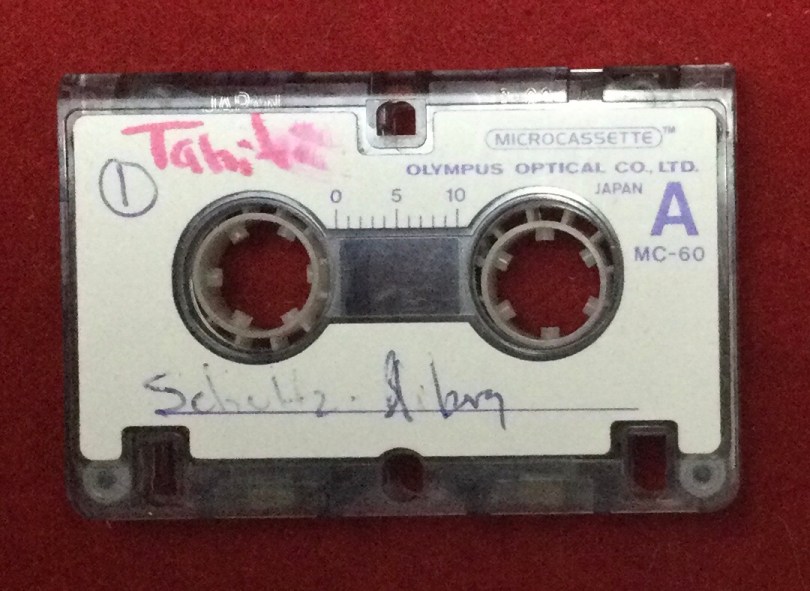
Microcassette is an odd choice. As far as I know they’re always mono and are really only meant for speech. Recording a performance put on for tourists makes sense if you’re a tourist. I picture an ocean shore at night, a dance floor on the level of the spectators who may be pulled in by the performers. The scene is torchlit and the air smells of heat and salt. The casual sexism of the male voices makes the recording seem tainted somehow. The concern over cameras and batteries, tired legs, feel so normal.

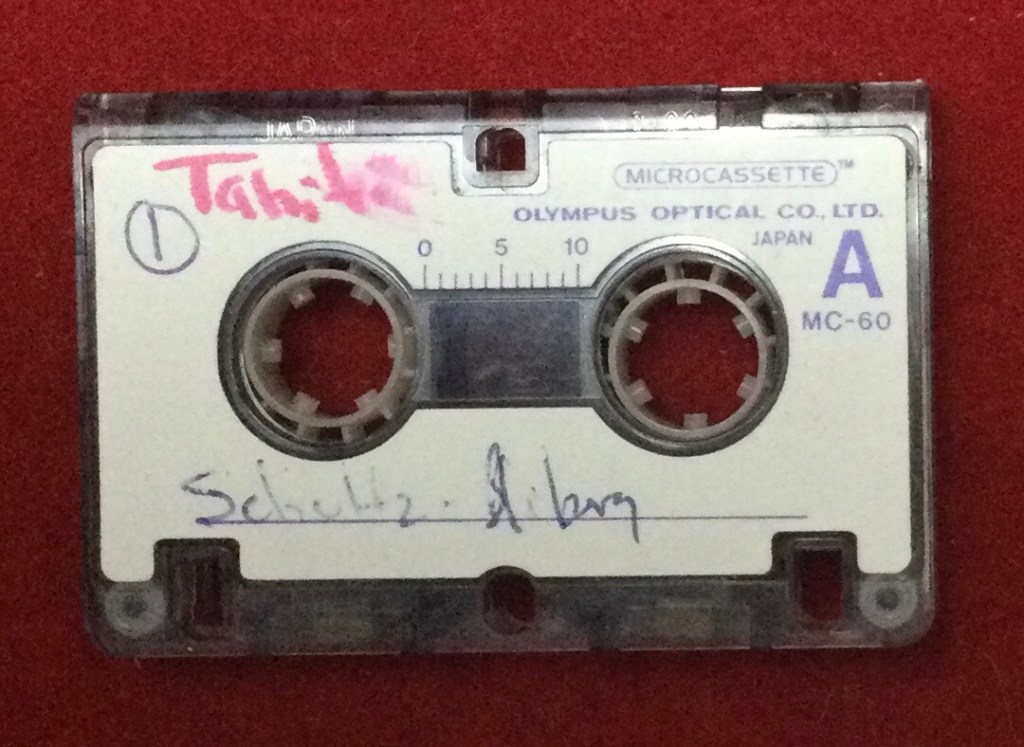
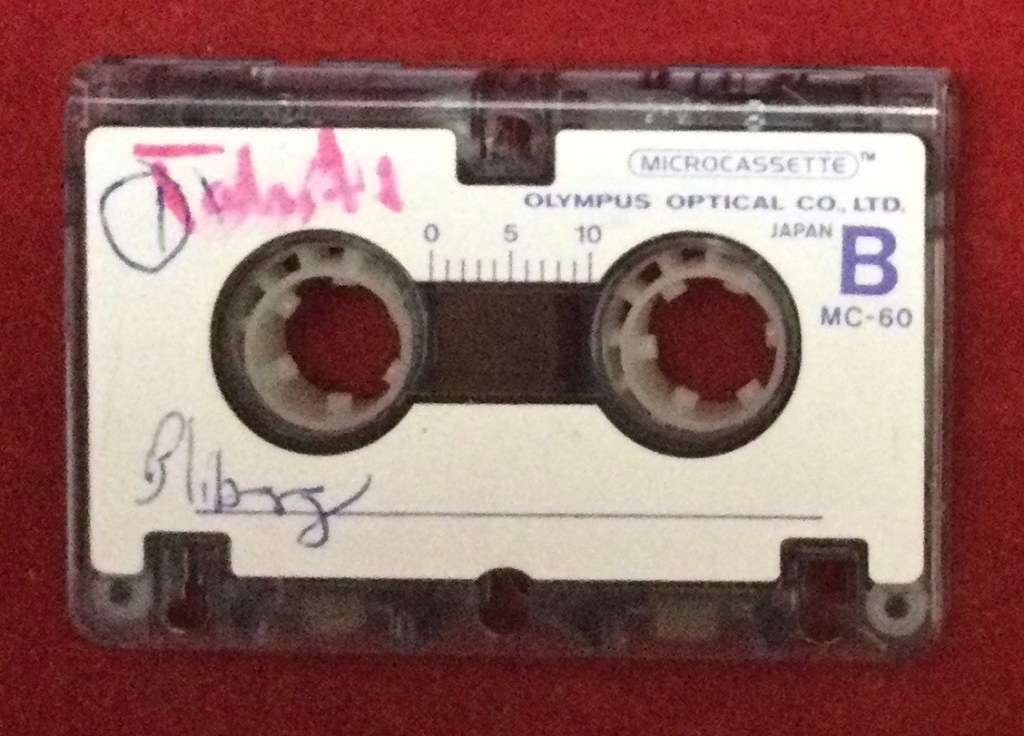
The found audio made available here was transcoded from a 60 minute Olympus microcassette. Red marker labels each side with the word “Tahiti” and in pen each side is also labeled with a circled number one. Side A is also marked “Schultz” and “Blib??”. Side B is has only the still indecipherable “Blib??”

Jobo Auto-Mat 35

A little bird that is definitely real and can obviously read minds told me that analog is king and people want to develop their own 35 mm film. That’s a noble cause and you even get a prize at the end. The prize is not Nobel. For 35mm home development you need stuff, the stuff you need depends on how you decide to go about it. This list will not include all the outliers, it’s going to be too long anyway. Let’s assume you have your camera, your exposed film, and your chemistry.

Option One

  • Changing bag
  • Daylight developing tank

Option Two

  • Auto-loading daylight developing tank

Option One comes with a whole suite of other choices. Metal or plastic tanks & reels being the main one. Metal tanks and reels have some solid things in their favor. They use less chemistry, in the same line, they’re smaller. For agitation, you gotta shake. They can also be kind of a pain ‘cause you need specific reels for each film format, and loading those reels is a bit of a learning curve. Oh, and they’ll last forever and can be cleaned in a dishwasher and dried in an oven. If you go plastic you get to choose what brand is the prettiest. Holy crap there’s a lot of brands. Some you can shake some you can’t and you have to use an agitator rod. Some can be sealed up and sat on a motor driven rolling base instead, which you can do with a metal tank if you try hard enough but that’s just asking for leaks. Plastic tanks pretty much all use more chemistry, but the reels generally adjust to whatever size film you shoot. It’s nice having a reel that’ll take 110, 127, 35, or 120. Versatility like that means they’re pretty big, so I hope you got a darkroom or a big ass changing bag.

Option Two has choices too. Well, a choice, have you got $200 or have you got $30? That can also be written as do you want to buy an Ars-Imago LAB-BOX, or search the second hand market for a vintage Jobo Auto-Mat 35. I know what you’re thinking, we all do, especially the birds. “Jobo isn’t that expensive as hell?” Not the one we’re after.

The Jobo Auto-Mat 35, circa old as heck.

The problem with the above is, how do you use it? Maybe you luck out and get a crumbling pamphlet when you buy yours, good luck with that. I’m told there’s some guy out there selling a poorly scanned pdf for about what you’ll pay for the tank. Maybe I’ll buy that pdf if I ever need to know the difference between the white and black sprocket. So, here we go, instructions on how to use a vintage Jobo Auto-Mat 35. First, let’s make sure you got all the parts.

This tank doesn’t require a changing bag because the exposed film cartridge is loaded, everything is put together, and then it’s developed. There’s other vintage tanks that do the same thing, a bunch of Soviet brands, Kodak, Jobo, Yankee, and others are all out there. They all work basically the same, with the main difference being that for some the film cartridge comes out before the chemistry goes in and with others the film cartridge comes out at the end along with the processed film. The Jobo Auto-Mat 35 is one that soaks the film cartridge in chemistry. That pretty much means you’re going to either use all-plastic reloadable cartridges if you bulk load, or disposable cartridges. Just something to keep in mind.

Step One: one is cutting your film leader. Trim the leader to a right angle, then clip the corners. You can actually cut them a little deeper than picture, in fact it works a bit easier if you do.

Trim it straight across and then clip the corners.

Step Two: fold the trimmed leader back about a quarter inch. Fold it away from the cartridge so that the unexposed edge is touching itself.

Fold it back a quarter inch.

Step Three: take the metal film clip off the bottom reel, it should be easy to remove. Slip the film into the film clip with them both curling in the same way, so that if you traced them they’d form an arc, not a wave. Tuck the folded over edge of the film into the folded over tab of the film clip. The photo at the left shows the orientation of cartridge and clip and the photo at the right shows how the film locks into the clip.

Step Four: slide the film cartridge into the cartridge sleeve. The protruding side of the cartridge spool should be on the open side of the cartridge sleeve.

Step Five: drop the loaded cartridge sleeve into the bottom film reel. The sprocket should be installed and you should take care to line everything up. Note that at this point you don’t want the film to be sticking out of the cartridge or cartridge sleeve really at all, it’ll just make lining things up harder later on.

Step Six: with the reel top and cutting tube threaded together, align the dots on the bottom and top reels. There are cut outs that fit together in both, drop the film clip onto the post on the slider on the bottom reel when you do. Note, the cutting sleeve must be threaded to the top reel, it only isn’t in the first photo so I could get a better shot.

Step Seven: this can really be part of the prior step, in fact it works better if you do it all at once but it’s twitchy as all-get-out. In the top film reel there’s a bump the recessed top of he sprocket fits into. In order to fit the sprocket to it, you need to slide the metal tab on the bottom reel that holds the sprocket it place to the side so you can pull it out just a hair. The hard part is getting the sprockets to align with the film sprocket holes. There’s recesses in the reels that help with it but the first time you try you’ll probably mangle the film a little, it’s fine, they’ll fall into place after a little wiggle.

Step Eight: drop the assembled reel into the tank bottom. Give it a slight twist until you feel it locked in.

If it’s locked in place, it’ll be level.

Step Nine: place the tank lid on. The arrow on the lid will line up with the chemistry pour spout, then give the lid a twist to lock it on.

Step Ten: turn the handle on the film cutting tube counter-clockwise to wind the film onto the reel. As the film winds on you’ll hear a double-click on each full revolution. A 36 exposure roll will be fully wound after 14 double-clicks. A 24 exposure roll will be fully wound after 12 double-clicks. A 12 exposure roll will be fully wound after 6 double-clicks.

Step Eleven: grab the bit of the top reel that sticks out of the lid with one hand and turn the cutting tube clockwise. It’ll screw down into the tank. You will very likely not feel it hit or cut through the film and that’s fine. Just screw it down all the way, you atrocious screw-up.

Ready to go!

Now, pour in your chemistry and process your film.

A Zine About Tarasoff Duty (aka Duty to Report)

I made a zine about mental health professionals duty to turn you in if you make threats to harm yourself or others. I’m conflicted about the whole thing but writing about the history of the situation that gave rise to the duty to report honestly makes me feel much less exposed when I’m seeing a mental health care professional.

Appellate-Gun Laws Are Fun

The Zine itself covers the situation that gave rise to the caselaw that established the Tarasoff duty in California. Seriously, the case is off the wall, like, I’m amazed it hasn’t been made into a true crime book or a movie or anything. It’s absolutely a tragic story but there’s so many unbelievable elements to it.

At the end of the zine is a list of the duty to report for each state. Tarasoff was a California case and as much as the rest of the US goes with what California does each state is still independent as far as a doctors duty to report a patients threats of violence goes.

This is not a work of fiction.

Organized Birds: update 1

No one asked but the primary work for the new zine, Organized Birds is done! I want everyone to appreciate that I agonized over how to get that smear just right. The key is to start below the line. I worry it won’t photocopy well but what’re ya’ gonna do.

I tried a version of the cover without the smear but it didn’t work for me.