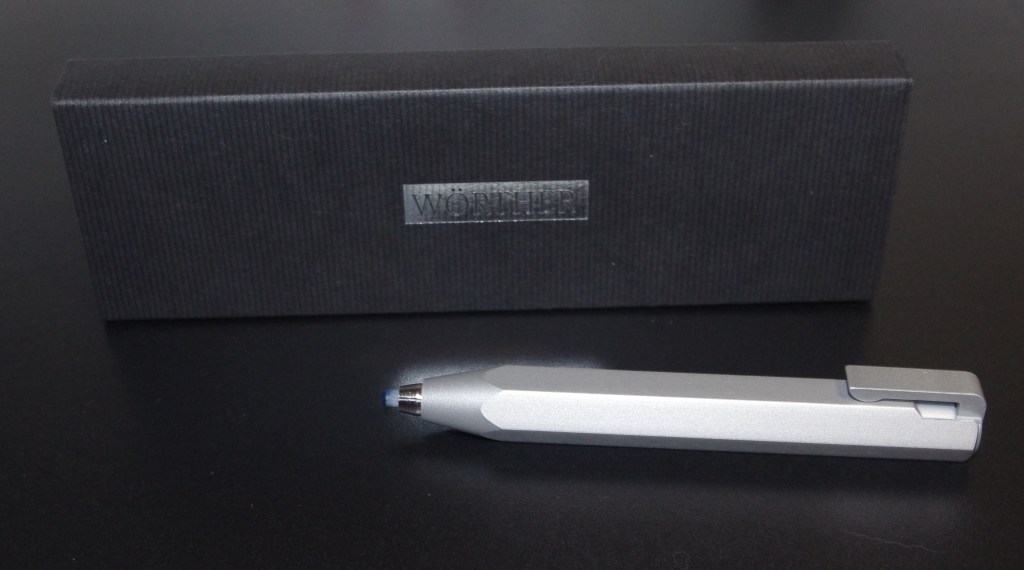
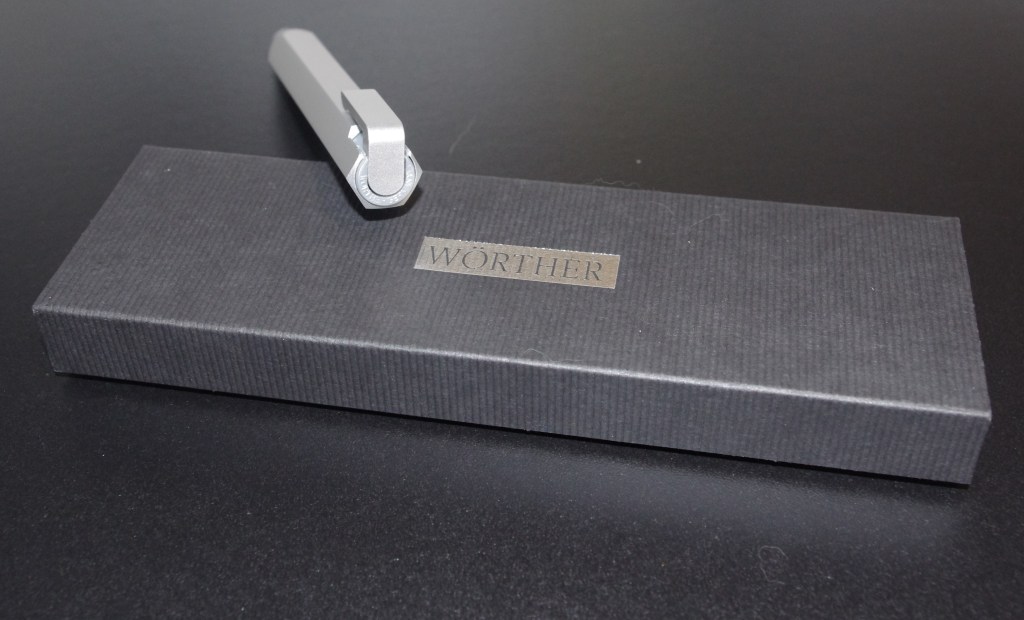
I found what from as far as I can tell is an old version of the pencil. I suppose it could just as well be an authentic version of the pencil with the previous being counterfeit. It doesn’t feel like the sort of thing that would be plagued by fakes, but of course the most commonly counterfeited piece of U.S. currency is a five and that feels like as lousy an idea.
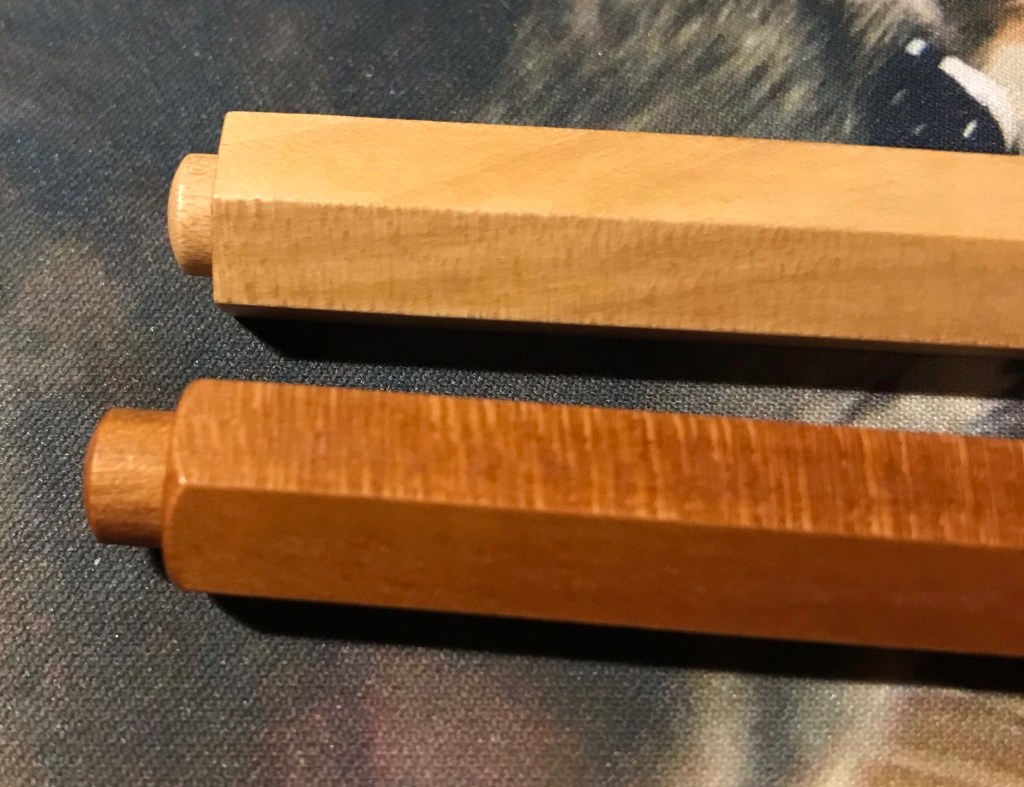
This edition has the notable feature of having “WÖRTHER GERMANY” in silver printing around the axis of the clutch release. The other version is entirely unmarked. Additionally, the angles of the facets at that end of the pencil are uniformly rounded. In the other version it’s a sharp edge.
I can’t explain it but the old version feels better. Functionally I notice no difference. By weight the old version is a touch over a gram heavier, but that’s all. I find that I prefer it.
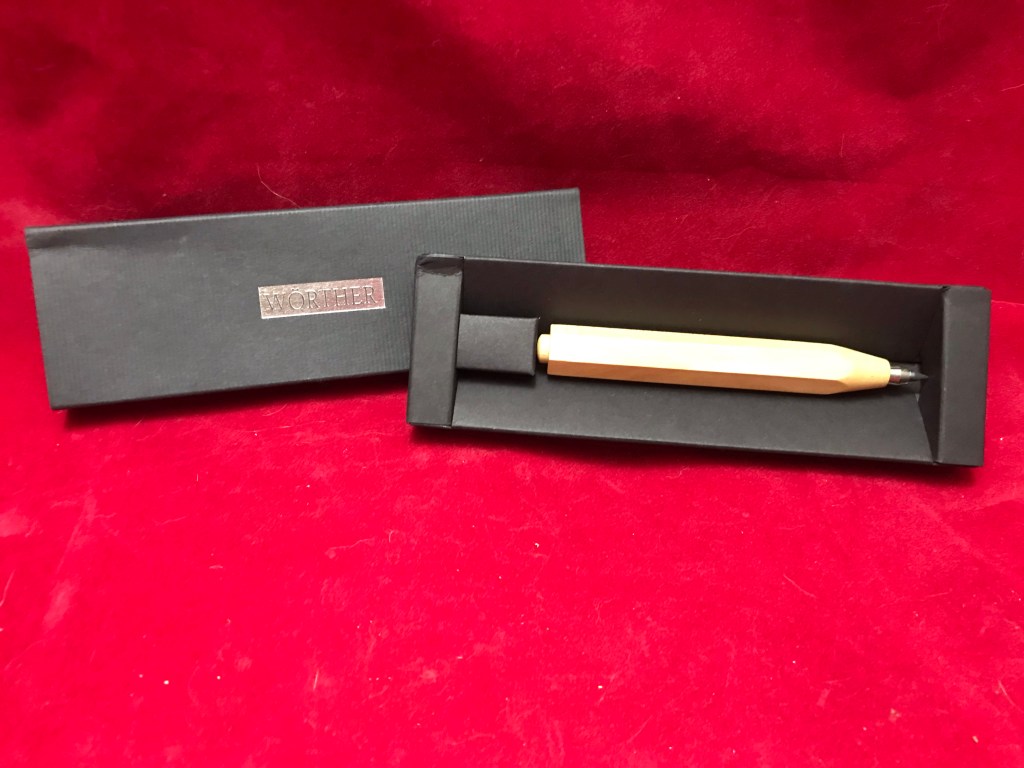
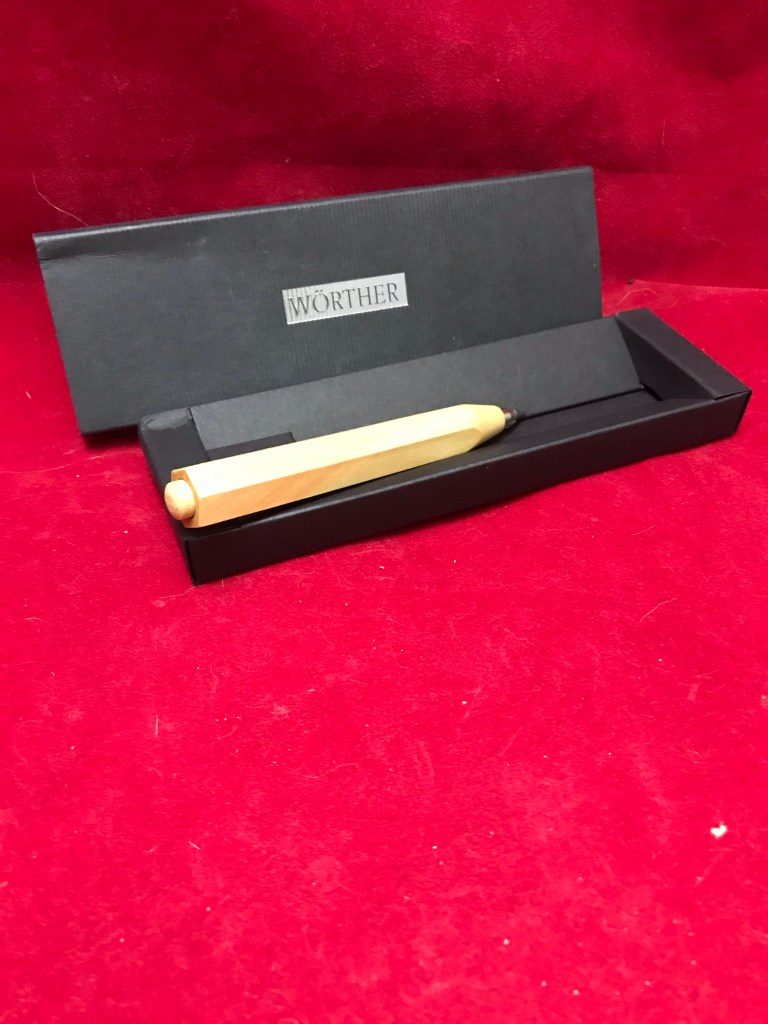
I picked up this pencil because I wanted the wooden Shorty 3000 to be much better than it was. One of the indictments against it I didn’t mention in that pencil’s review was something quite apparent visually. Between the wooden body and the metal clutch leaves was a plastic nose cone. The transition from body to cone was right where you’d try to hold it, and just sharp enough to be uncomfortable. Enter the Hexagonal, closer in appearance to the shorty, seemingly “all” wood, and lacking a clip.
I say closer to the Shorty, but that’s only if you judge the closeness by how it feels in hand. Compare the Shorty 3000 and the Hexagonal to the Shorty mechanically, looking only at the clutch release and it’s clearly a sport. Normally, I’d abhor the lack of a clip but the six facets are broad enough to stop any rolling. In fact, at it’s short length the absence of the clip helps it due to the practicality of rotating it in use.
A lead over two millimeters is a strange animal. Decimal leads need no pointing. The standard two millimeter technical pencil leads generally have a specialty pointer, as do the five and up leads. Around three, there’s nothing. One’s either burning up the sandpaper or cursing a blade. Unless you get through all the stages of grief to acceptance. Know you’re not going to have a sharp point, maintain the point you do have by rotating the pencil ever now and again. Without a clip bumping the hand it remains comfortable in all positions.
I like this pencil quite a lot. It’s alive to the touch, visually appealing, and practical. For $26 USD plus shipping I’d buy it again if it was lost or damaged. I do not expect it would be universally loved. One must be comfortable with a short instrument to find in it anything but novelty.
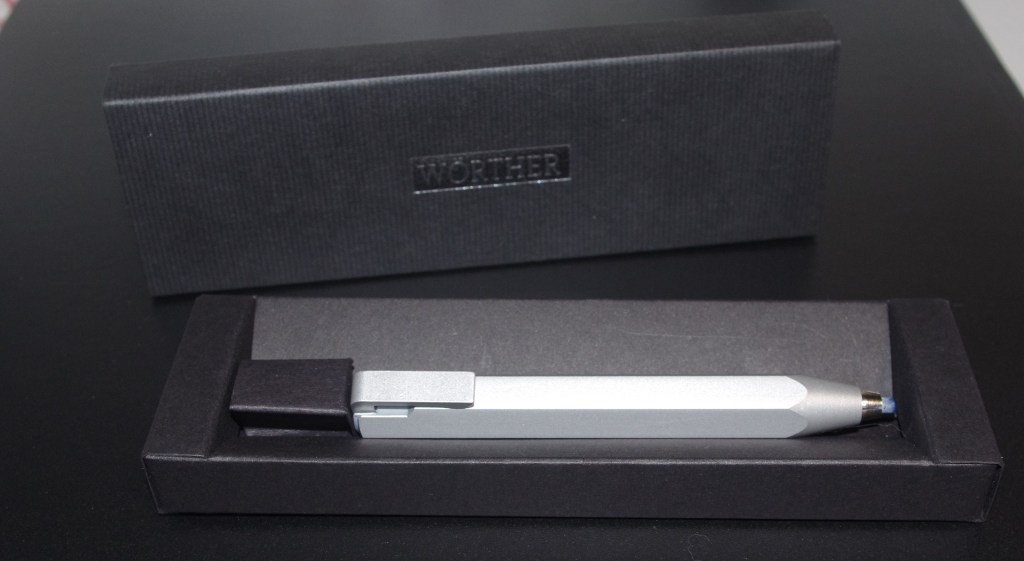
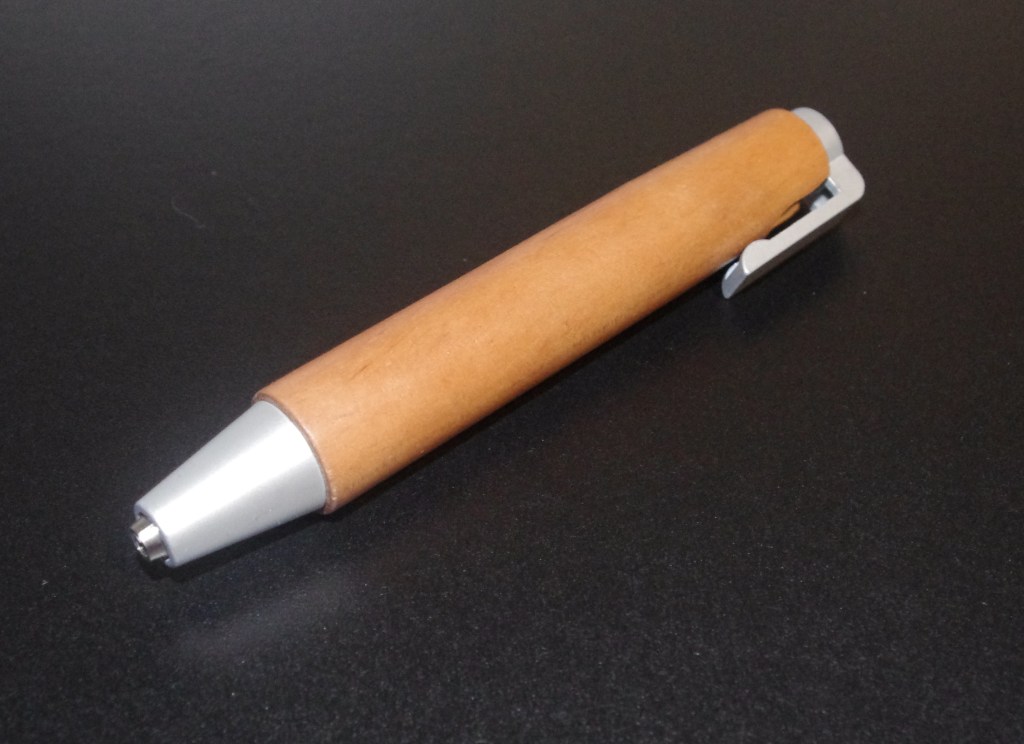
The main point I hold against my other Wörther pencil is it’s mostly plastic construction and the resulting exceedingly light weight. They offer the Shorty in all plastic in a rainbow of colors which I wrote off as certainly too light and all wood which I passed over for the same reason. In the pursuit of something more substantial I picked up the pencil in “Natural Aluminum.” Calling it that appears to be done to draw contrast with a polished, knurled, or brushed aluminum that’s common on writing instruments.
As with other variations of the Shorty the clutch is four segmented, the body is hexagonal in section, and the button depresses quite deeply. Unlike other variations the clip is hinged and smoothly pivots up from the body. It’s a small thing, but a nice touch, even if it’s unnecessary because the clip naturally stands off from the body a bit more than one may expect. That the clip is also aluminum, with the same finish as the body was the right design choice. The leaves of the clutch are a shiny steel, and there’s a small crescent of plastic on the button (embossed with the brand), based on which I expect Wörther could have easily gone with a steel or plastic clip; so their choice is appreciated.
It’s not a heavy pencil, but feels substantial, and for forty five dollars it’s not a pencil you’re going to buy for each color lead you plan on using (like you would with the seven dollar rainbow plastic models). It’s a pleasant pencil though, particularly if you like the Wörther leads and want to use those in a native pencil. It’s chunky and something about the natural finish makes it feel delicate in a way another metal wouldn’t. The six facets of the wide hexagonal body make it hard to hold comfortably in a non-standard grip. This could be good or bad depending on if you’re trying to break a bad habit or not.
If I lost it I would be sad, but I don’t think I would replace it. I could see buying another as a gift. I do not expect it would survive unscathed knocking about in a pencil box, it might not scratch as readily as I expect it may but the sharp lines where the facets come together seem only too delicate.
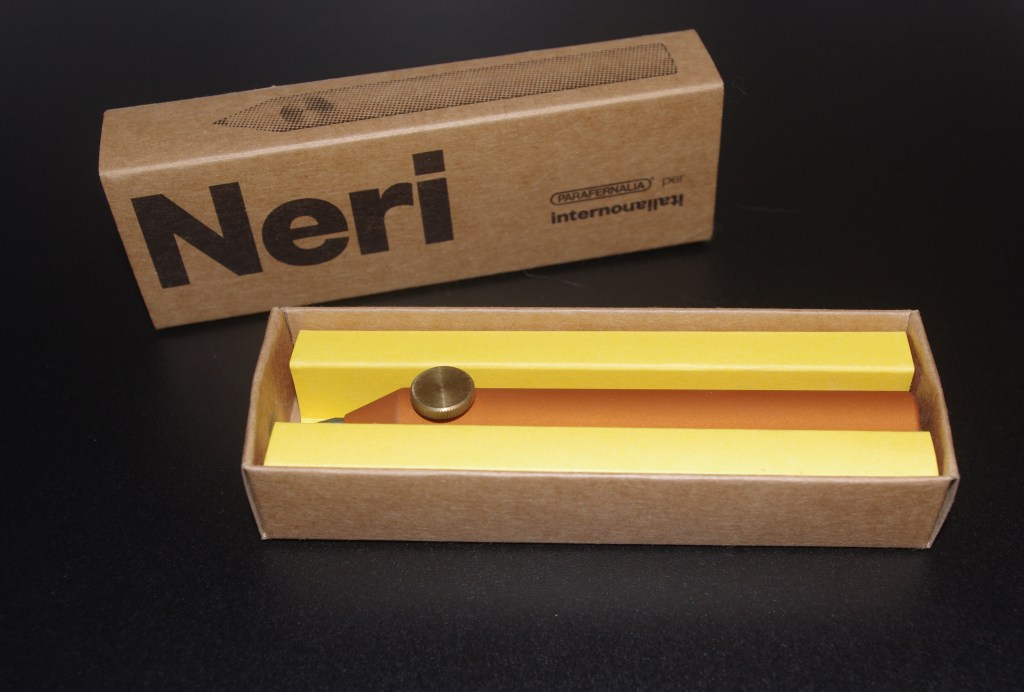
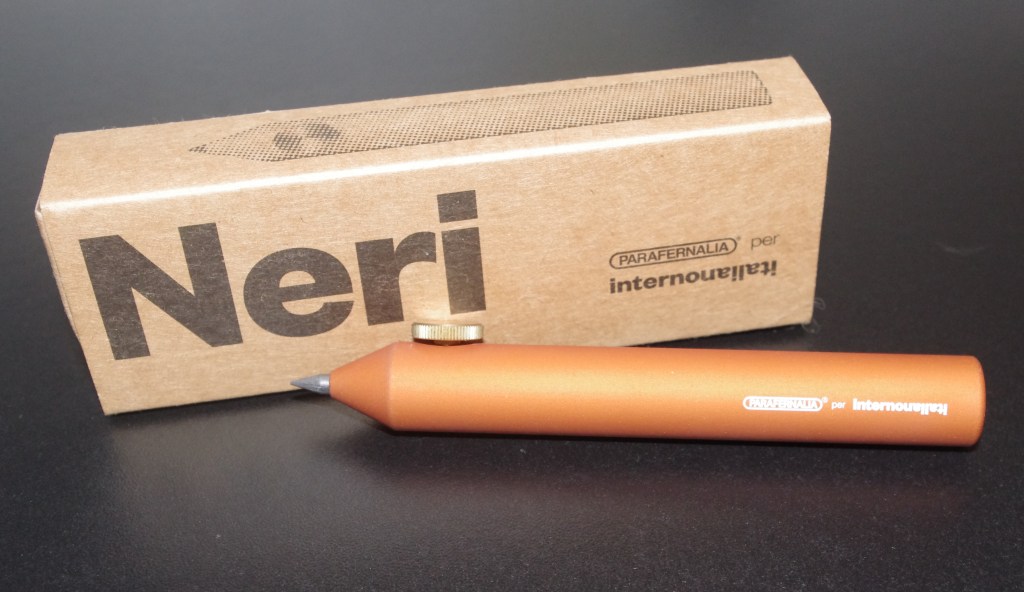
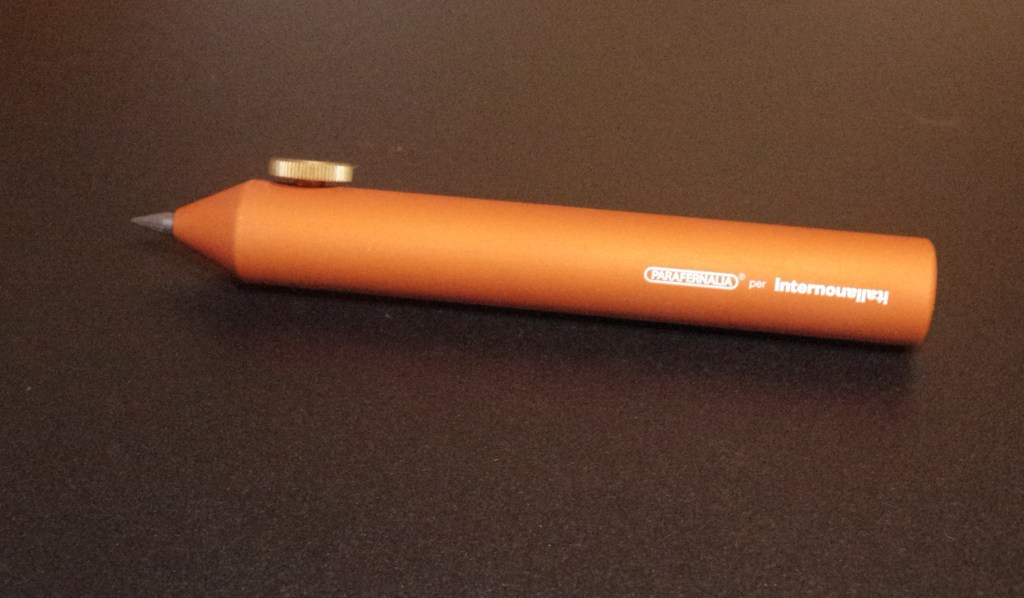
I like a short pencil, and this is one. It’s a bit unusual in that it’s neither a propelling nor a clutch pencil. If we’re giving it a description it’s a set screw pencil. There’s no complex moving parts, just a tube with a tapered end, a threaded hole and a thumb screw. That doesn’t seem like a whole lot to get for fifty six dollars. Parafernalia is a design focused Italian brand and the Neri pencil is manufactured by them for Internoitaliano who are another Italian brand that if anything is even more design focused.
Neri, is a whole lineup of pens and pencils although calling it a lineup may be a bit generous. It’s really just one design iterated into just enough variations to give a collection minded person something to buy multiple over and over. And what exactly would you be buying? An anodized aluminum tube with the most unpleasant texture of any material I have ever encountered.
The pencil looks good. That’s all you should ever do with it though, look. It’s not something that you can un-touch, which having touched it is the only thing I ever want from it. The texture could be described as broken fingernail, or fine sand eyedrops. It’s so excessively unpleasant that I’ve never marked a page with it. As I wrote above, it looks nice. The orange anodized finish is without flaw, and the printed branding is perfectly executed. The unique and profoundly simple design is reminiscent of one of those carefully laid out fonts where all you can see is the words unless you focus on the letters and start to pick up echos of everything that went into it.
I like it, I do. But I wouldn’t buy it again and if I could exist in a timeline where I never bought it and felt the too-fuzzy almost frothed aluminum finish on it I would.
Available from: No, I will not help anyone find this cursed object.
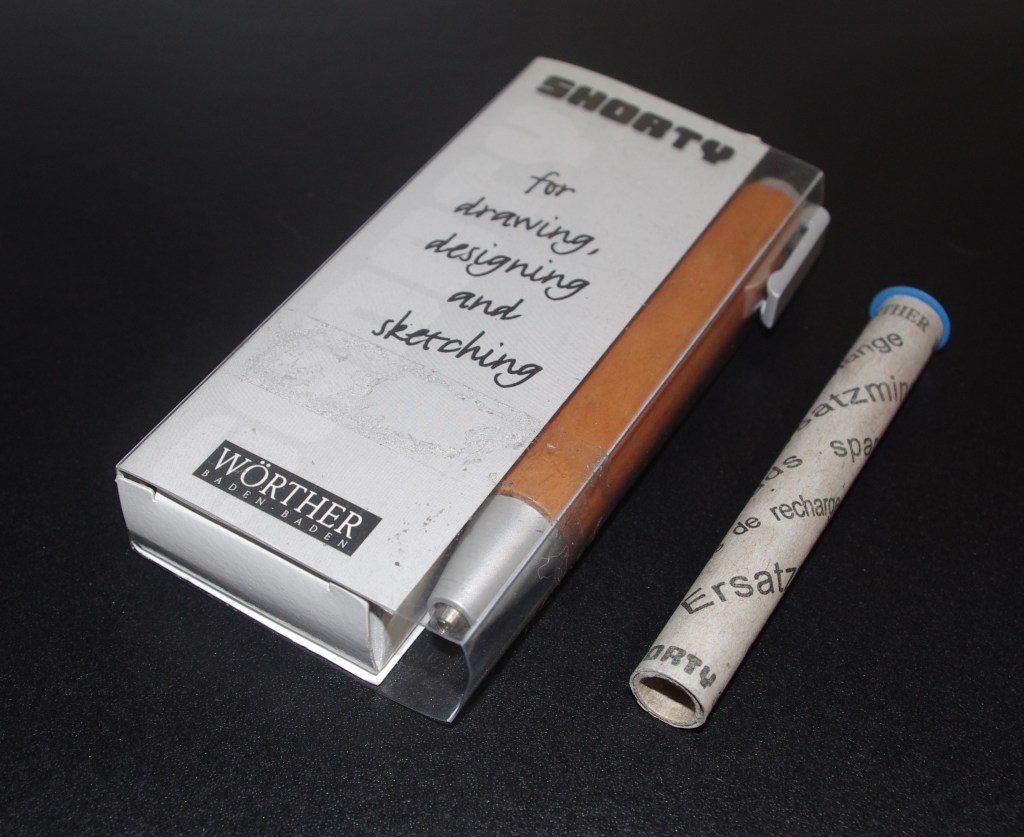
Wörther is a German stationer, although that might imply more depth to the brand than is warranted. Near as I can tell they offer only 3.15mm short form clutch pencils and matching leads. Their pencil is called the Shorty and it’s generally hexagonal in section, which makes the round barreled Shorty 3000 someone of an outlier. It’s worth noting that if you want 3.15mm leads Wörther themselves is the only source. Fortunately, Koh-I-Noor offers 3.2mm leads which fit and 3mm would likely fit as well if it were possible to find without getting flooded with results for 0.3mm propelling pencil leads.
The leads Wörther offers are oil based, except for their graphite leads and although available in a range of colors come only in single tubes of four leads each for from two to seven dollars. This is potentially expensive (depending on the convenience of one retailer or another) for oil based leads as they wear so quickly. A benefit of the fast wearing leads is the lack of a need to point them. Because it’s so soft, and so much is consumed even in drawing a line of moderate length, one needs only to rotate the pencil to keep lines a constant width. Wörther goes so far as to make that point in the advertising copy. Emotionally, it comes across defensive as they frame it around their justification for not including a pointer. I suspect that except for the graphite leads a pointer or bladed sharpener would eat the oil based leads so rapidly that people would complain.
I may be wrong, but I think these are meant as marking pencils rather than writing or art pencils. Wörther touts them as able to write on glass, X-rays, wood, fabric, tile and virtually any surface. The wood finish Shorty 3000 looks wonderful, but in the hand feels exceptionally cheap. This is probably because apart from the thin wood body, the four segment clutch, and whatever spring is inside it’s made of plastic. And it’s rather lightweight plastic at that. I found mine used for sixteen dollars, including shipping.
I would not replace it if I lost it, or if worn out. I wouldn’t feel bad if upon loaning it to someone it wasn’t returned. I don’t mean for this to sound like any sort of indictment or criticism of the brand. They make a range with significant variety and I think this is just a cheaper model.
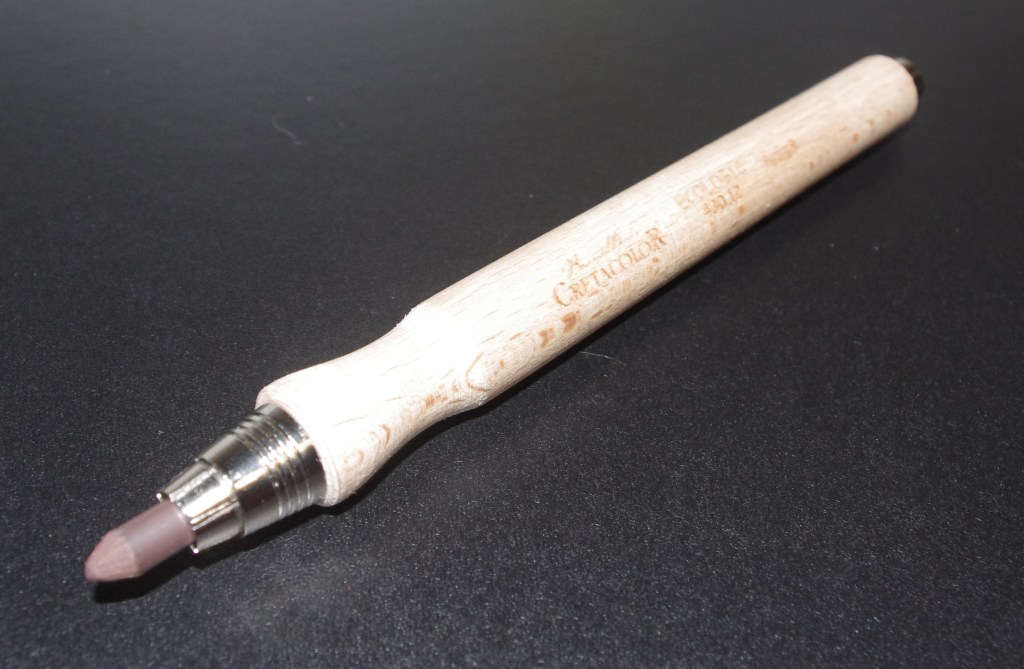
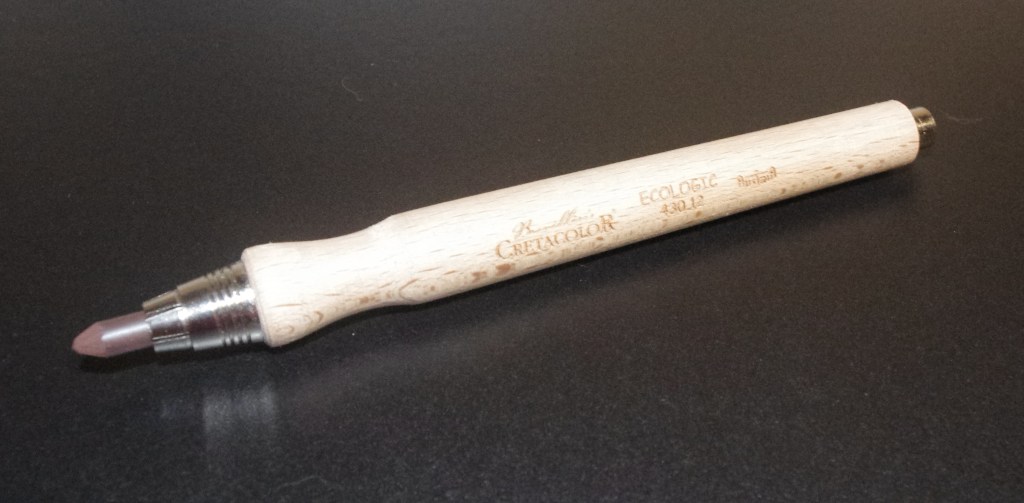
Cretacolor is the first brand listed here which is really an art materials company. The odds are good that if you’re the owner of a lead holder you’ve picked up leads from them at least once. The Ecologic is their purportedly environmentally friendly lead holder though they make a point of advertising it as suitable for charcoals. They would have to be processed charcoals, only the thinnest vine will fit. In consideration of fit, Cretacolor sells a wide variety of 5.6mm leads and they are longer than would fit in the two short-form holders reviewed above, but are the longest suitable for this holder.
The clutch mechanism is all metal of a uniformly reflective finish. It does not unscrew from the wooden body and it is unclear if it is glued or simply press-fit. I do not know the type of wood, but it feels like something common rather than some level-the-rainforest exotic. It’s sanded smooth but unsealed and not lacquered. It tapers somewhat towards the clutch release while the other end has a significant hour-glass grip. It’s not uncomfortable.
At retail the lead holder is from ten dollars to the high end of less than twenty dollars. This may feel expensive for the unfinished wood and common metal. The impression one gets is that it’s made to be inexpensive and more than that, it is made to feel plain. It’s the kind of lead holder one might be provided at an adult-education life drawing class. It will do the job but is not so appealing that it’s apt to walk out with a student. Neither is it so precious as to be upsetting if it does go missing.
If I lost it I wouldn’t buy it again. It feels as if it would last through four years of art school, provided it isn’t dropped. I don’t know if it’s justified or not, I do feel though, that upon impact with the floor from a moderate height the wood may crack and split. Perhaps it’s better to worry about how the wood is sure to discolor upon contact with smudged fingers or knocking around in a pencil box. On a glossy surface dust is expected to brush off, on this raw wood it’s sure to impregnate.
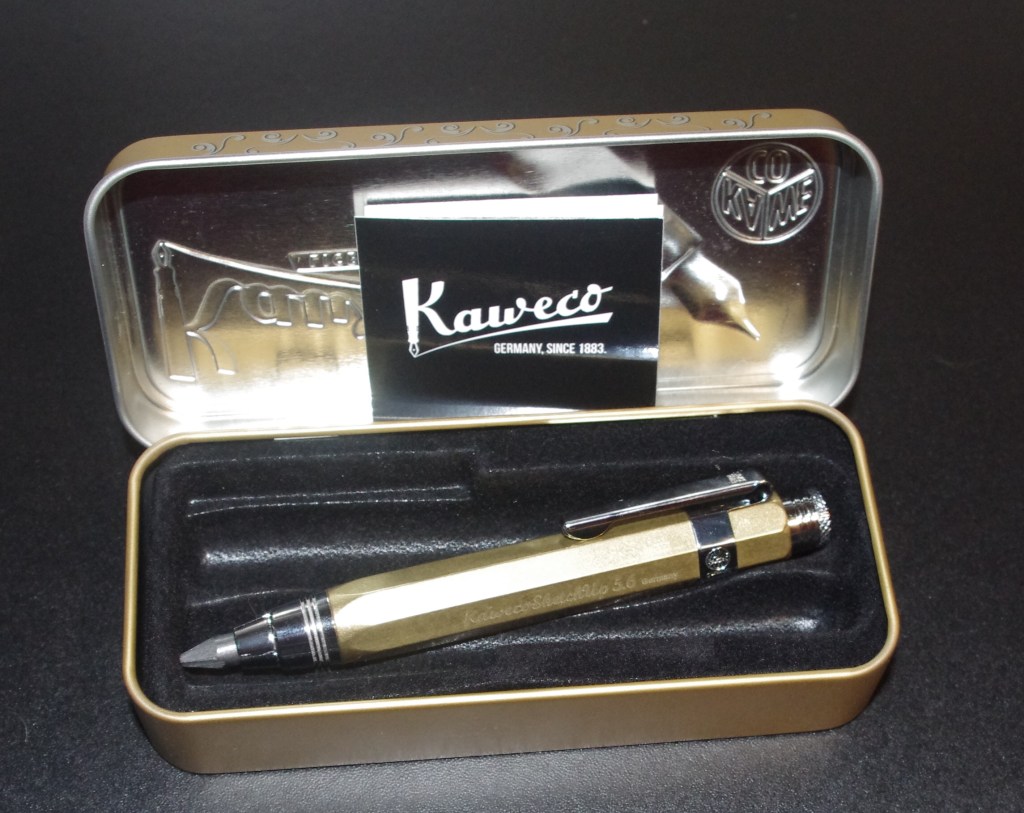
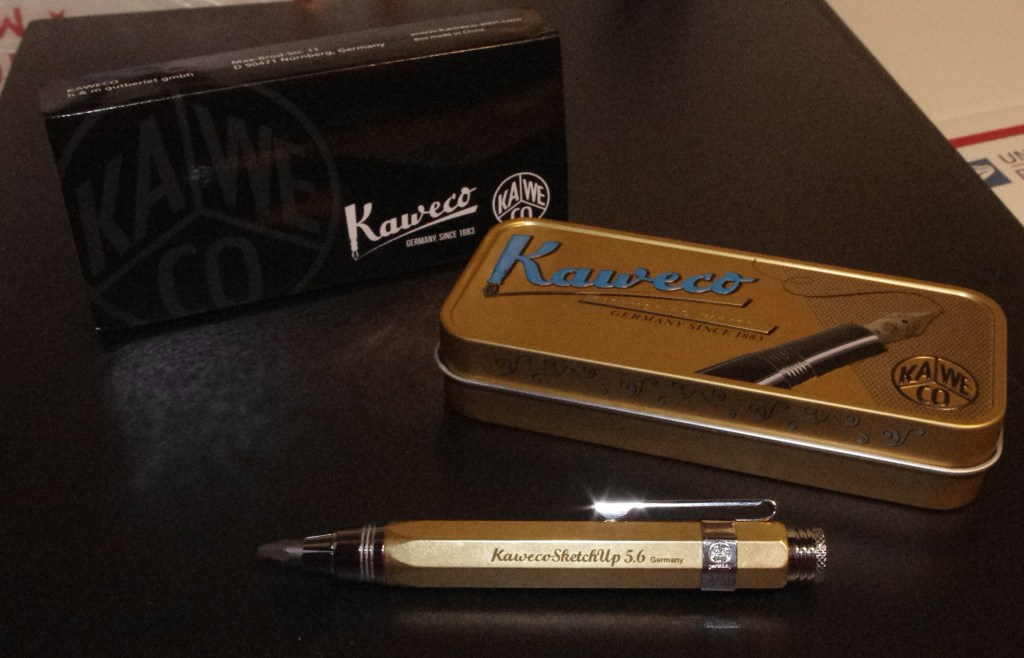
Kaweco is a German stationer with broad and deep coverage as far as their writing instruments go. For short form pencils they offer 5.6mm and 3.2mm clutch pencils and 0.5mm click propelled pencils. Materials for the 5.6mm versions are limited to one in brass, one in aluminum, and one in black plastic. It’s exceptional that they only offer the plastic one in black because they offer everything else in multiple colors. I selected the brass version because the idea that it would change appearance over time appealed. Mine is unlikely to acquire any sort of patina, because I’m not a fan.
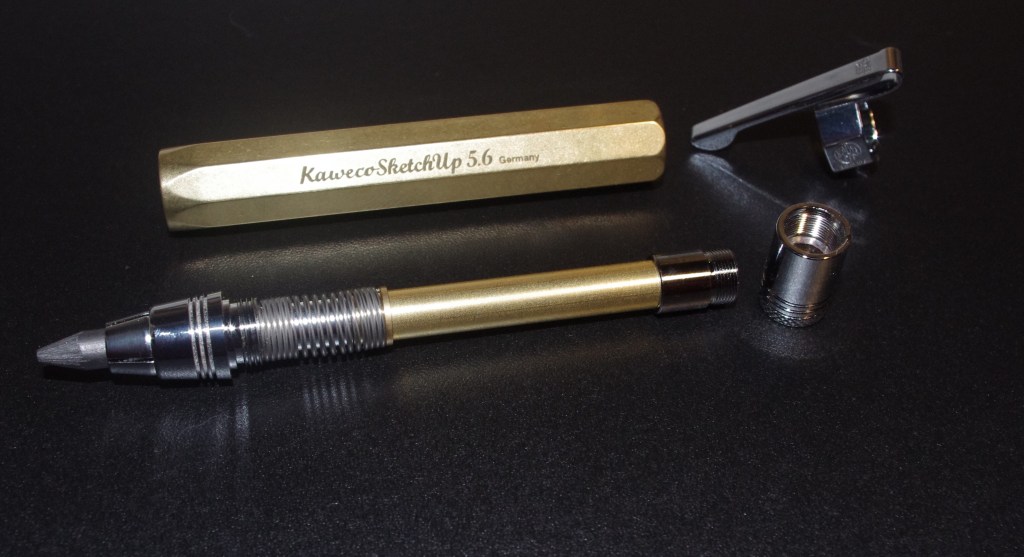
The pencil is heavy and doesn’t have a clip unless you bother to buy a slide on one from Kaweco. I could forgive this if the clip was more snug, as it is it slips and slides too much for any sense of security. For those who hate a clip I’m sure it’s welcome as an optional rather than built-in feature. For the octagonal body it’s mostly unnecessary as a roll-stop. Even if it doesn’t roll, it’s going to slide if you put it down in the wrong orientation on any sort of slope. This is a product of its slick finish and substantial weight. That weight is balanced and as a result how it is gripped governs the feel in use more than the design of it does. It’s unfortunate.
Depending on the retailer the brass finish Sketch Up will be in the general neighborhood of thirty dollars. In all honesty it’s overpriced, but this is due in some part to the decisions Kaweco makes regarding packaging. A cardboard sleeve around a stamped and painted tin is, excessive. As you might find in a draftsman’s 2mm lead holder the push button holds a lead pointer, and threading that as well as the mechanism and body certainly contributes to the cost of manufacture. Note, it’s an omnidirectional pointer, and not a bladed sharpener.
I wouldn’t purchase it again if I lost it and I don’t project that it would wear out within any individual lifetime. My expectation is this would be exactly what some other artist could be looking for. Why shouldn’t it be? Brand loyalty is a thing and it’s not ugly even if it is a brutalist Soviet apartment tower of a thing. Kaweco has a brass pocket style fountain pen and I could see an owner of the pen justifying the purchase of the pencil.
The brand “e+m” is a German stationer and every instance of their name I can find is in lowercase. They have been around longer than both k. d. lang and her inspiration, e. e. cummings, though I have to imagine they were not always averse to capitalization. Who knows, German isn’t bound by my native English conventions on capital letters. They make a variety of products, writing instruments and the usual affiliated objects. I have a pencil and lead pointer.
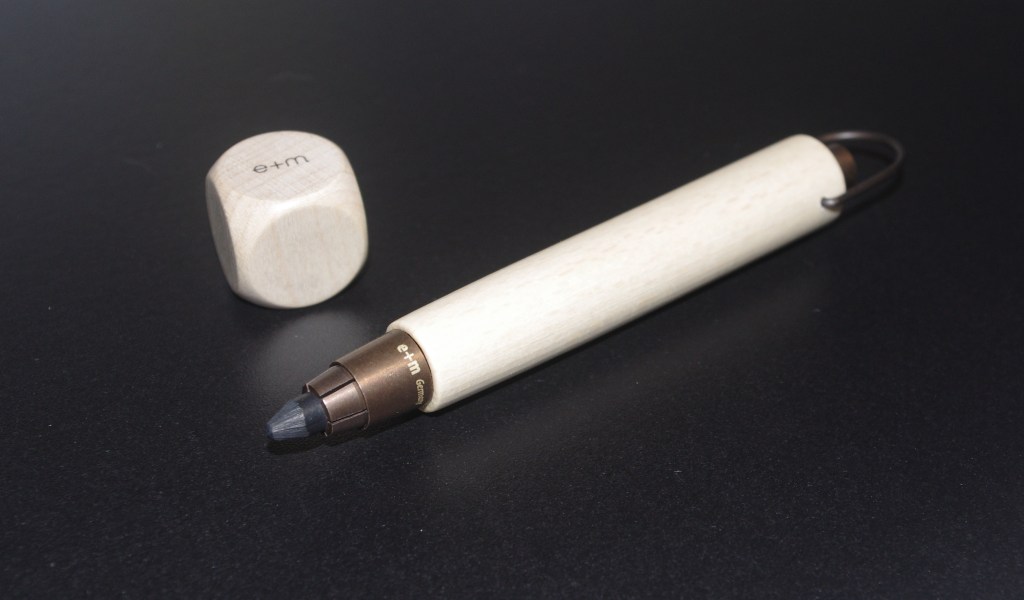
The Clickman by e+m in beechwood, is a short body, 5.5-5.6mm lead, push button clutch pencil. They also offer a ballpoint ink insert which transforms it into a pen. I selected it in beechwood because wood should look like it, and of the various models I noticed at the time none of them had anything that will stop them rolling (essential for a round body), save the Clickman, which has a lanyard horseshoe. It was pennies more than seventeen dollars. I will have to obtain a lanyard.
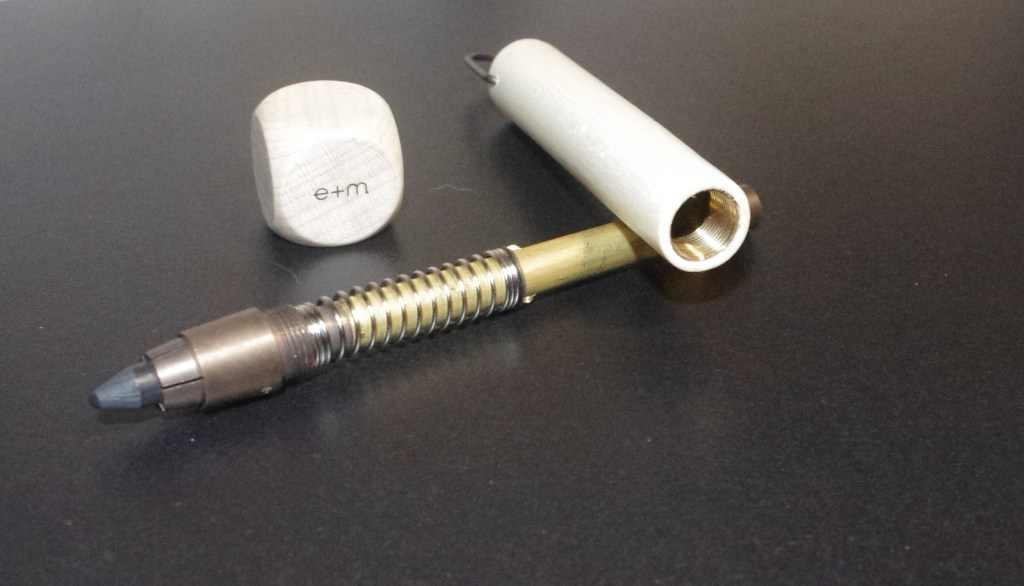
An all-metal mechanism of brass and steel with a brown (possibly anodized, both aluminum and titanium could be made that color) finish gives the pencil a reassuring weight. That weight is tip-heavy, rather than balanced, and it feels better for it. I don’t know if this was a purposeful design consideration, it seems like it would have to be, there’s no other reason to have the amount of mechanism beyond the six segment clutch sticking out from the body. The smooth finished wooden body has a metal inner tube with threads at the tip end. I don’t know if threading the metal and pressing or glueing it into a wooden cylinder is a cost saving measure; a hit to material cost certainly but threading wood consistently and cheaply feels like a tall order.
As far as the strength of the spring on the clutch goes it’s noticeably stiff. This is good, particularly for something in the 5.6mm diameter, as it means softer leads or even (thin) vine charcoal can be grasped by the clutch without slipping. There are, so far as I can tell, no corners cut. If I lost it I would buy it again. I cannot imagine that I will break it or wear it out to the point of inoperability. Somewhat oddly the photos I can find online from various retailers all show the brand emblazoned on the wooden body near the push button. On my example there is no marking on the wood, instead it is printed on the metal surround of the clutch mechanism.
There is no integrated lead pointer in the pencil. So for the cost of the pencil I purchased one from their available lineup. I consider it a point in their favor that a pointer is not integrated. The last thing one should have is a dust filled pointer screwed into their pencil. Searching reveals that e+m only offer wooden pointers (as distinct from a bladed sharpener) and those are available in a variety of stained and natural woods. There are two form factors, one bulb shaped and the other die shaped. The die shaped model is the objectively superior choice.
Pointing is an infrequent activity with a 5.6mm lead, or it should be. The only way to work small with such a wide lead is to keep it pointed, and that being wasteful, it’s best to work at A5 or larger. Starting with a point, turn the pencil frequently and it will yield a more or less consistent line until the cone is as much as half gone, when it should be re-pointed. That advice should be thrown out the window if you’re heavy handed or working with soft or oil-based leads.
 Uncredited Work