
Look, I want there to be a conspiracy to put chemicals in the water to make the freaking frogs gay, at least as much as the next person. Probably more. It would be amazing, mostly because thinking deeply about what could possibly motivate such a thing would surely quiet the voices. The fact the fertilizer Atrazine is a teratogen in amphibians and may cause hormonal changes in as much as 10 percent of male leopard frog tadpoles which turns them into hermaphrodites. It’s a great illustration of ignorance that something affecting gender presentation is “making the frogs gay” because sometimes knowledge isn’t even as deep as a puddle. I remember thousands of tadpoles boiling desperately in rapidly evaporating puddles. Tragically, we are continuing to learn that puddles aren’t nearly as deep as they were thought to be.
Over the course of a life an individual may accumulate things which are best described as “oh no.” Common examples of this may be a weapon found in a storm drain or fished up by a magnet tossed off the side of a bridge. A matched set of phalanges or a jaw bone pulled off a skeletonized corpse and secreted away before notifying the authorities would fall in the same category. It’s hard to blame anyone for collecting something like that, the opportunity may never come again. This needn’t be something found though, it could be something produced. Disclosures in a diary that should never have become a physical thing apply. That’s just the easy stuff. The careless artifacts things that may derail an otherwise pedestrian life. Of greater, but general rather than acute hazard are intrinsically dangerous products.

It’s possible through intentional or incidental action to end up with something genuinely dangerous. Pharmaceuticals are an easy, familiar, example. Go to the doctor. Get a prescription. Have a pharmacy fill it. Have a bad reaction or find it ineffective. New prescription. Old leftovers. Now here’s this chemical that most people shouldn’t be exposed to. It’s hazardous to the point that no less than two licensed professionals have to collaborate in order for someone to even purchase it. Someone who is explicitly not a knowledgeable professional must now dispose of it. Trash it, flush it, pitch it down the garbage disposal. Take it to an organized pill-drop where the claim is it will be “safely” incinerated. All of that puts it in the environment. Even medication that is consumed ends up in the environment, or at least the metabolic products of it do. This is the end condition of everything that isn’t ejected into extra-orbital space.
Everything ends up in the environment. From there it ends up in everything else. One way of dating old things is to test them for strontium-90. Ever since nuclear weapons were tested, strontium-90 is present in the environment. Bottle of wine from the 1800’s? If it contains strontium-90 it’s fake. Oddly enough that’s a rather harmless thing, there’s plenty of other stuff that’s been dispersed on a much larger scale. Lead is a perfect example and it’s accessible enough to be a reasonable example. Lead in gasoline is a thing of the past. Lead in the environment is forever. Lead in paint is found not just in buildings but in glazed pottery, cheap jewelry, and toys. Lead is disturbingly common in plumbing, if not water pipes themselves, then the solder holding the same together. The body treats lead like calcium, and purges itself of lead with about as much ease as it does calcium, which is, none at all. Microplastic is the lead of the new millennium. Above, I wrote about the individual responsibility of a person as a source of pharmaceuticals in water. As with greenhouse gasses, individuals are a source, but manufacturing is the main contributor to such an extent that it’s not even worth mentioning an individuals contribution except as an example more familiar to most than a pharmaceutical manufacturing facility.
And it continues from there. Agricultural run off causes harmful algal blooms when it’s not directly poisoning the watershed. Human waste puts viruses in the water at high enough levels that COVID is monitored at a municipal level by testing at wastewater treatment plants. Don’t worry about a conspiracy to poison the water, worry about the carelessness and corruption that’s triggering boil water advisories and enabling videos of people igniting their tap water. Amoeba, eating brains or only causing a week of dysentery. Parasites, coliforms, mercury, chemicals, purification byproducts, and this is all in the first world where tap water is “safe”. Don’t concern yourself with what’s being put in the water. Understand that what we know is in there is one thing. What we need to be afraid of is what we don’t know is in there, what we don’t know about what is in there, and what will be in there tomorrow because of what we’re putting in there today.
I stopped drinking water straight from the tap forever ago. I bought bottled water when it was popular. I read the municipal water quality report. I never had a boil water advisory, but I boiled. I got the best reverse osmosis activated carbon filter I could find. I bought the weird empty-tasting distilled water jugs in the laundry aisle. I got a bottle that runs on batteries and blasts anything that may be alive in there with sterilizing ultraviolet light. I became concerned about all the dead bodies I’ve been drinking. So I bought a strange water-purifying bottle with the vaguely religious name of Grayl. It’s replaceable filters mechanically remove particulates, including microplastics, sediment, and silt (which is oddly apparently not a sediment I guess). It’s activated carbon removes chemicals like PFAS, chlorine, and chloroform. Through some electroadsorption process it filters out heavy metals like lead, arsenic, and chromium.
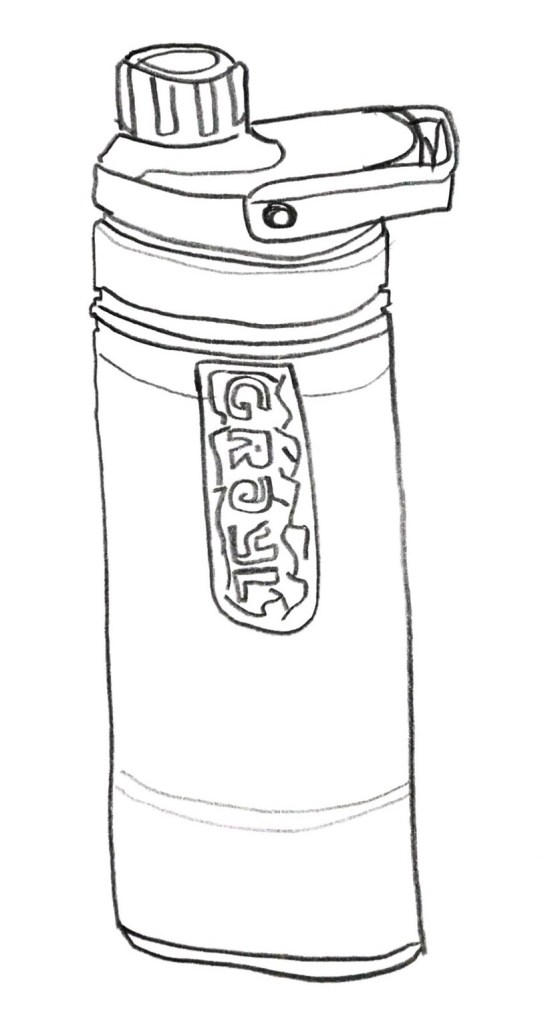
Their ad copy includes a lot more contaminants, more living things, more of everything being removed. That’s important to me, removal. I don’t want to drink dead bodies. What happens if I accidentally think about them and then they suddenly aren’t inert corpses anymore?! What then!? No answer for that is there! I have absolutely no reason to believe there is anything in my water present to be removed. It’s probably a bad sign that I feel like I must remove something that is almost certainly no there.
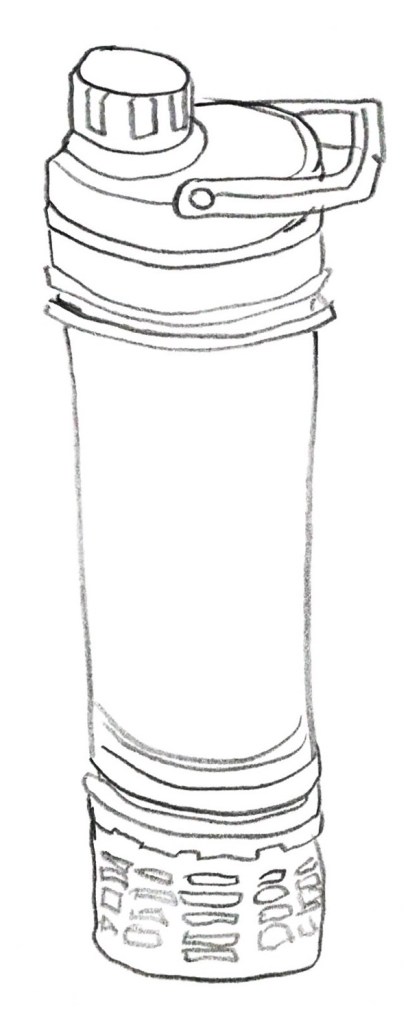
The Grayl Ultrapress (and the larger Geopress which is the same but too large for a cup holder) has three basic parts. There’s the outer cup. This is the dirty side and is filled to the mark with source water. There is also the inner bottle, the inside of which is the clean side. Drinking access to clean water is available at the top of the inner bottle. The bottom of the inner bottle is open, and a replaceable filter threads in there. It is well gasketed, and it’s wise that the gaskets are part of the filter so that they are replaced when the filter is and therefore don’t wear out.
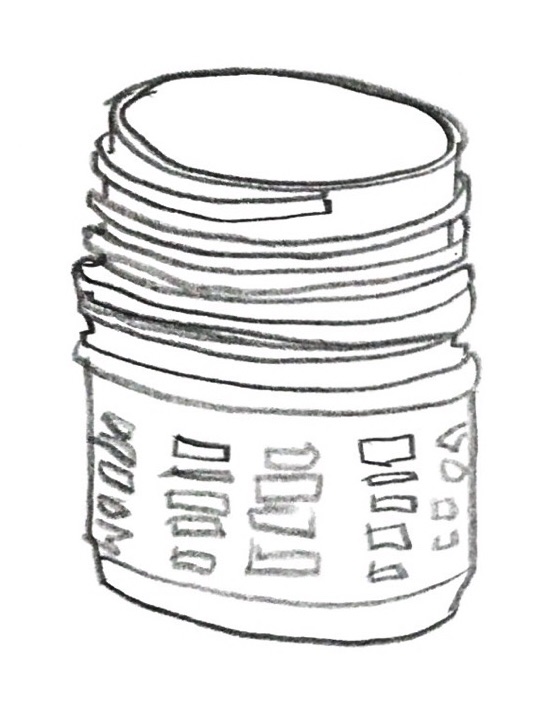
When the empty inner bottle is pressed into the filled outer bottle water is forced up through the filter. This is a lovely design. Unlike many filters, one is not obliged to suck on a straw, an objectively unpleasant way to drink. There’s also no extra bits, no hoses or pumps. The two bottles, they are the pump. Grayl offers a titanium version, and that’s odd as it expects you to boil water in the dirty outer bottle. From everything I’ve see their customer is expected to be the camper, the wilderness backpacker. I think they may be missing an important class of customer. They should market to the harmlessly paranoid, we’re sure to use more filters.
 Uncredited Work