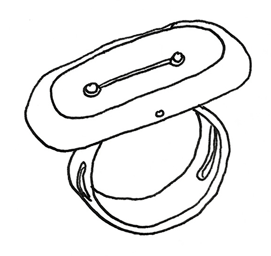
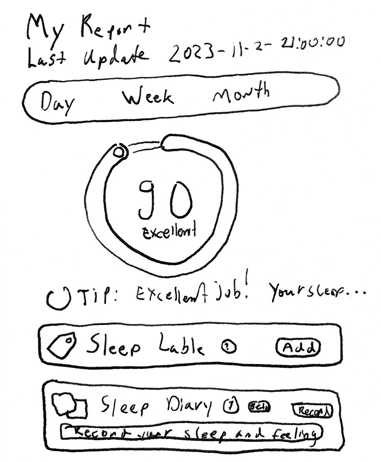
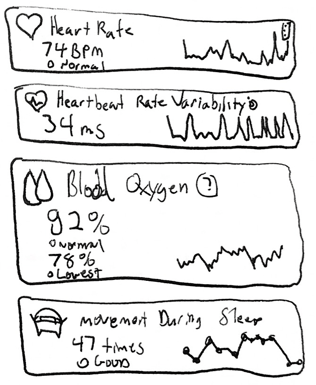
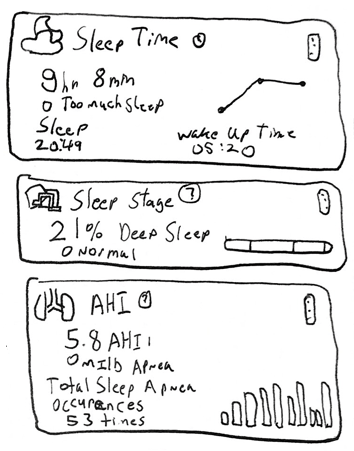
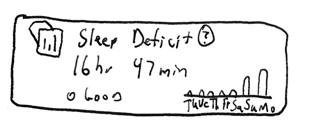
Sleepon produces a largish lozenge shaped device that unlike most of the products in the marketplace specifically and only tracks sleep. According to their ad copy it tracks: sleep stage, breathing rate, heart rate, body movement, snoring and et cetera. I expect the et cetera is a more professional way of indicating that whatever else can be extrapolated from the data gathered by the existing sensors is already or will be pending app updates. Those sensors are an accelerometer, blood oxygen concentration monitor, and a heart rate monitor. If that doesn’t seem like terribly much, one should keep in mind that any one sensor can provide multiple tracked values either alone or in conjunction with another sensor. A heart rate sensor will not only allow for recording of current heart rate, but heart rate over time and therefore heart rate variability. It all comes down to what can be done with data in the app. First, about the device itself. It’s something that fits into a silicone ring style holder to be worn on a finger overnight. The holder is open on two sides, one opening is for the sensor compliment which faces the inside of the finger. The other opening is opposite, and exists for the proprietary two contact charging base. The charging base is rubberized on the bottom, and has a noticeable weight, which is nice, but a micro USB female input which is not nice. Officially the ring has a two night battery life, you may get three, but in practice a habit should then be formed where the ring lives on the base and is put on the finger just before sleep, and is returned to the base upon waking. That’s a further important point. It’s constantly sampling, and is not intended to be worn except while sleeping. In my particular situation this is inconvenient because I have a tendency to lay down and sleep whenever and wherever I think I might be able to. There’s no assurance that it’ll be beside the right nightstand. Of course wearing the device is important because the bigger the dataset the more potentially useful it is and the greater the chance that once can track improvement over time. What might be improved? Quite a bit, and to get an idea of what bits exactly it will be necessary to see what the app tracks. Blood oxygen level, resting heart rate, heart rate variability, time asleep and time awake, sleep stages (light, deep, REM, or awake), the time spent in each, and finally though perhaps most interestingly apneas and hypopneas. Impaired or obstructed breathing during sleep can do worse things than inflict snoring on anyone laying beside. Low oxygen levels during sleep are a significant contributor to morning tiredness, or headache. The app will recommend some immediate actions such as avoiding sleeping on ones back, but it will also suggest weight loss and exercises to improve fitness and lung function. That’s where having a lot of history comes in handy. Along those same lines the app offers a thoughtful export feature for everyone who’s not averse to a little data mining. The app itself takes the time period approach and provides daily, weekly, and monthly top level tabs in addition to an aggregate sleep score out of one hundred. There’s the option to create labels to assign to ones sleep and the ability to maintain a sleep diary in the app. Those are both features which only allow for getting out of them what’s put into them. Next comes sleep time and sleep stage. For each of these it’s going to give you a formal rank of the Goldilocks variety. A value called AHI is presented, where the acronym is for apnea hypopnea index. I expect very few people will be aware of or comfortable with that measurement initially, over time it should become familiar and useful. Heart rate and heart rate variability follow, along with blood oxygen, and a log of movement during sleep. The movement can be sort of obscure on its own, but viewed against the sleep stage graph it proves more interesting. I’ve found that it, at times when I wake but the tracker does not register myself as having awoken, may just register significantly increased movement instead. The tracking of ones sleep deficit is interesting as well. It’s one of those things that people are aware of, and likely do not keep track of in any concrete way. It may be slightly too easy to let it turn from a novel metric into a source of creeping anxious dread. For one hundred nine USD it may seem a bit expensive for a sleep-exclusive device. For anyone thinking that, I’ll just point out that they hit all the core metrics, don’t lock anything behind a subscription, and for people who really enjoy the way cellphones killed the wristwatch only occupies a finger, and then only while sleeping. Consider picking one up from their US shop, or for international orders.
 Uncredited Work